· Submitted to all seven agencies · 57 slides
Project Overview
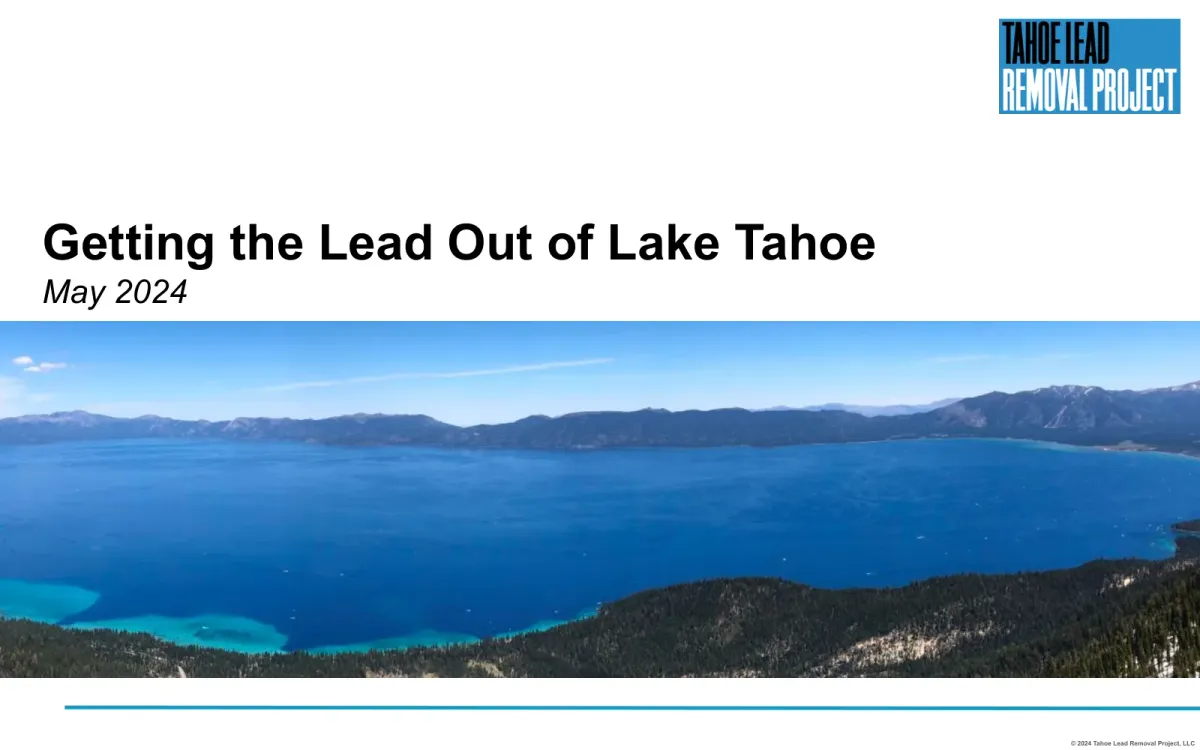
Getting the Lead Out of Lake Tahoe
Contents
- Introduction
- Situation Overview
- Key Risks from Inaction
- Our Approach to Removal
- Project Execution & Partners
- Initiating Permitting Process
1. Introduction
Who we are
- We are the Tahoe Lead Removal Project, a community initiative focused on removing inactive lead telecommunication cables from Lake Tahoe
- Our efforts grew organically from a group of Rubicon Bay neighbors advocating for removal due to the potential risks of lead contamination
- An ongoing lawsuit between California Sportfishing Protection Alliance (CSPA) and Pacific Bell (AT&T) also centers on these cables
- We are neutral, unaffiliated with either party, and separate from that litigation
- Instead, we propose a direct path to removal through collaboration
Why are we reaching out?
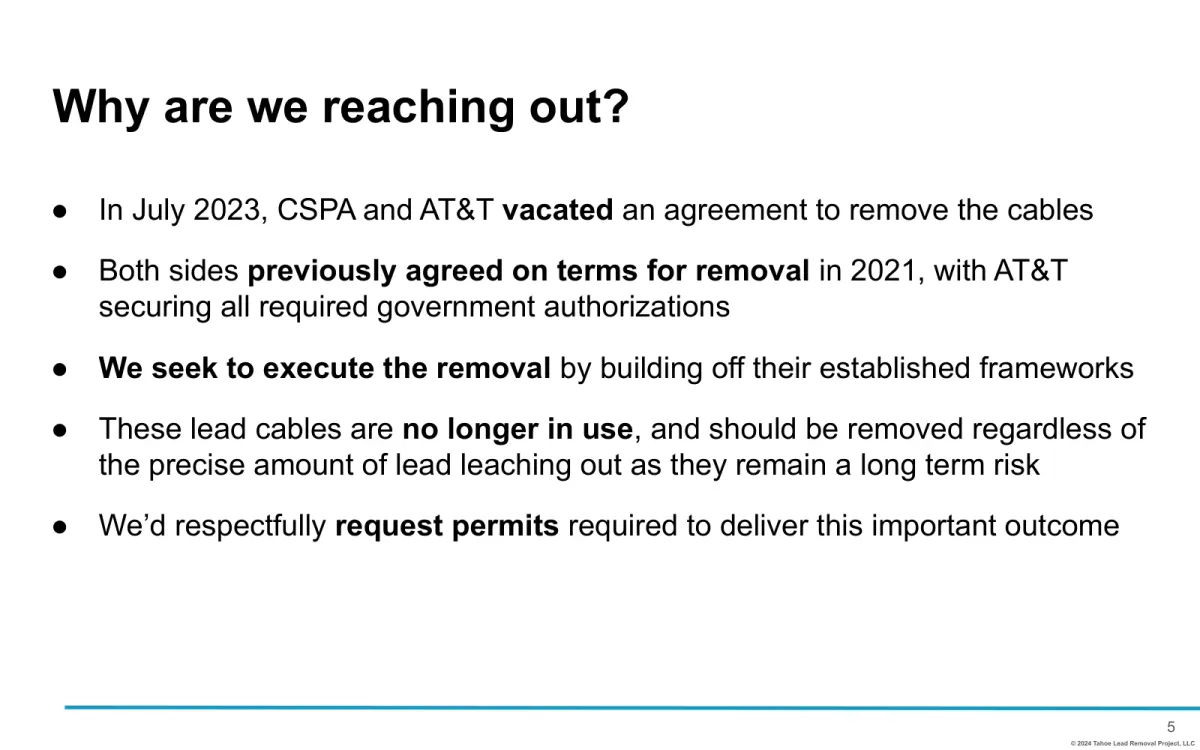
- In July 2023, CSPA and AT&T vacated an agreement to remove the cables
- Bothsides previously agreed on terms for removal in 2021, with AT&T securing all required government authorizations
- We seek to execute the removal by building off their established frameworks
- These lead cables are no longer in use, and should be removed regardless of the precise amount of lead leaching out as they remain a long term risk
- We’d respectfully request permits required to deliver this important outcome
Our Aims
Get the lead out! Bring together stakeholders with the best possible partners to deliver the appropriate outcome for the future
Reorient path forward! Shift focus from a legal dispute with national implications back to removal, now driven by our local community
Proactively address risk! Eliminate the potential for a worst-case scenario that could irreversibly damage Lake Tahoe’s water quality
2. Situation Overview
Situation Summary
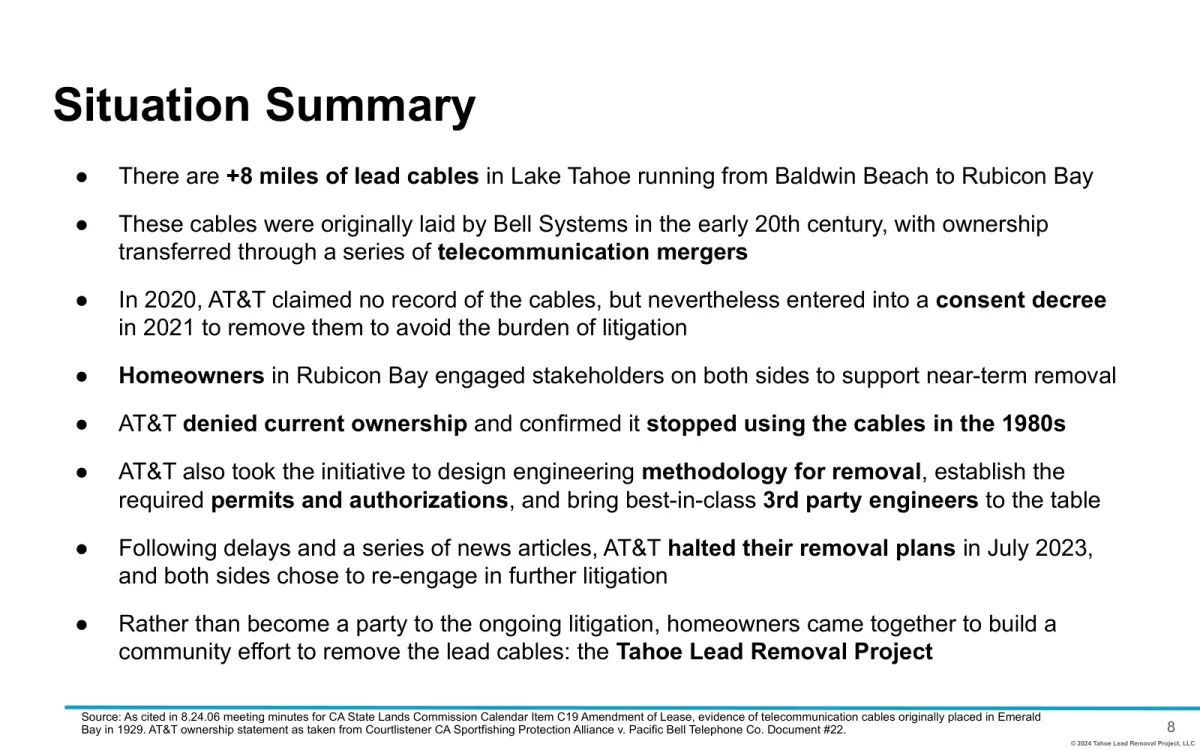
- There are +8 miles of lead cables in Lake Tahoe running from Baldwin Beach to Rubicon Bay
- These cables were originally laid by Bell Systems in the early 20th century, with ownership transferred through a series of telecommunication mergers
- In 2020, AT&T claimed no record of the cables, but nevertheless entered into a consent decree in 2021 to remove them to avoid the burden of litigation
- Homeowners in Rubicon Bay engaged stakeholders on both sides to support near-term removal
- AT&T denied current ownership and confirmed it stopped using the cablesin the 1980s
- AT&T also took the initiative to design engineering methodology for removal, establish the required permits and authorizations, and bring best-in-class 3rd party engineers to the table
- Following delays and a series of news articles, AT&T halted their removal plans in July 2023, and both sides chose to re-engage in further litigation
- Rather than become a party to the ongoing litigation, homeowners came together to build a community effort to remove the lead cables: the Tahoe Lead Removal Project
Source: As cited in 8.24.06 meeting minutes for CA State Lands Commission Calendar Item C19 Amendment of Lease, evidence of telecommunication cables originally placed in Emerald
Bay in 1929. AT&T ownership statement as taken from Courtlistener CA Sportfishing Protection Alliance v. Pacific Bell Telephone Co. Document #22.
Where are the lead cables?
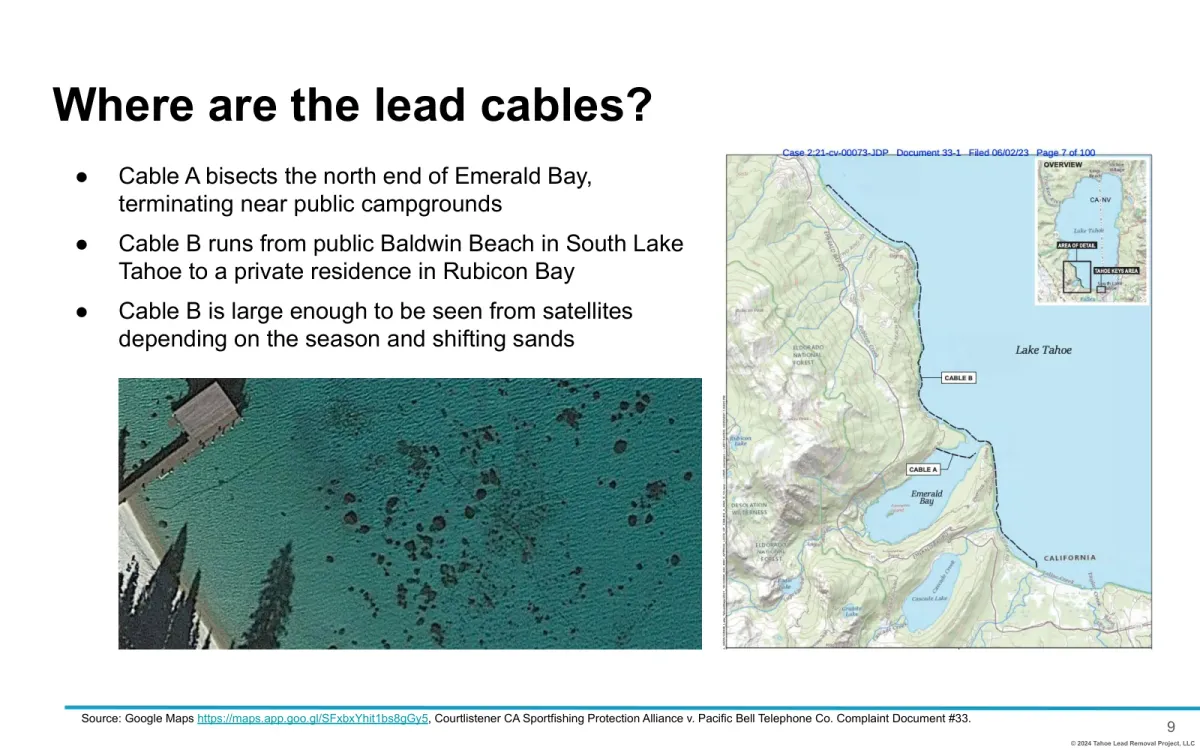
- Cable A bisects the north end of Emerald Bay, terminating near public campgrounds
- Cable B runs from public Baldwin Beach in South Lake Tahoe to a private residence in Rubicon Bay
- Cable B is large enough to be seen from satellites depending on the season and shifting sands
Source: Google Maps https://maps.app.goo.gl/SFxbxYhit1bs8gGy5, Courtlistener CA Sportfishing Protection Alliance v. Pacific Bell Telephone Co. Complaint Document #33.
What is the current state of the cables?
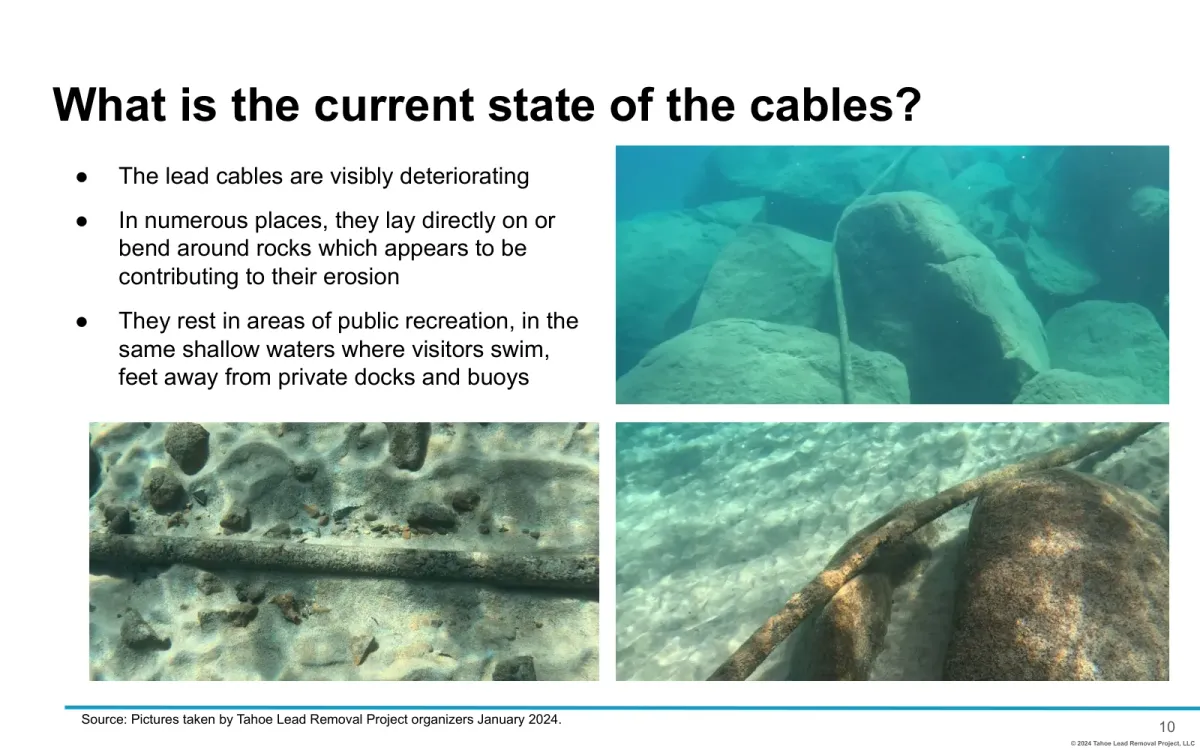
- The lead cables are visibly deteriorating
- In numerous places, they lay directly on or bend around rocks which appears to be contributing to their erosion
- They rest in areas of public recreation, in the same shallow waters where visitors swim, feet away from private docks and buoys
Source: Pictures taken by Tahoe Lead Removal Project organizers January 2024.
Our petition
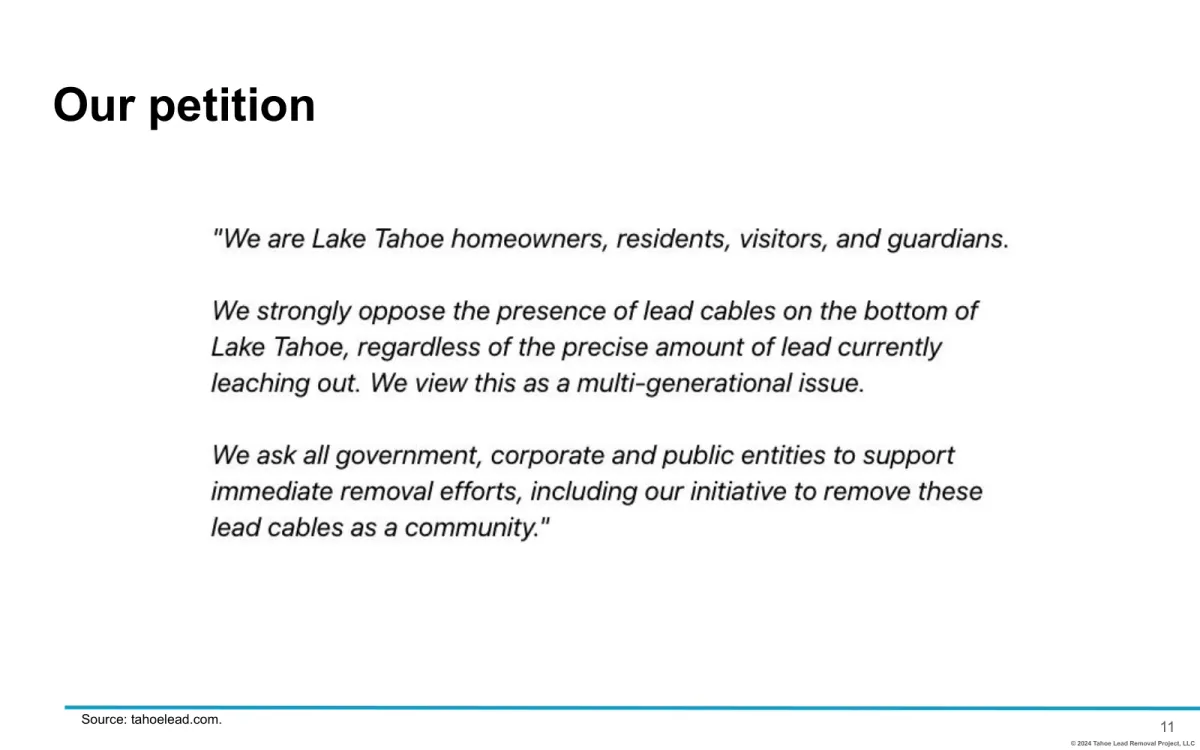
Source: tahoelead.com.
Our petition’s positioning
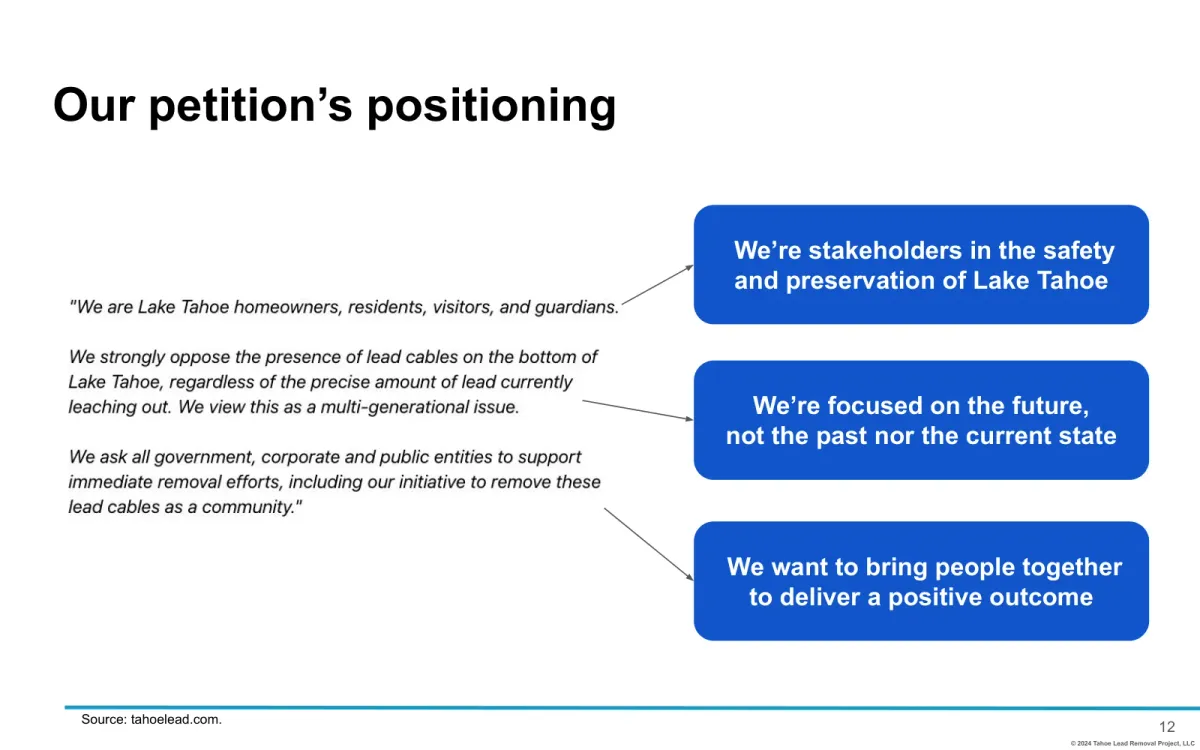
Source: tahoelead.com.
We’re stakeholders in the safety
and preservation of Lake Tahoe
We’re focused on the future,
not the past nor the current state
We want to bring people together
to deliver a positive outcome
The presence of lead must be addressed
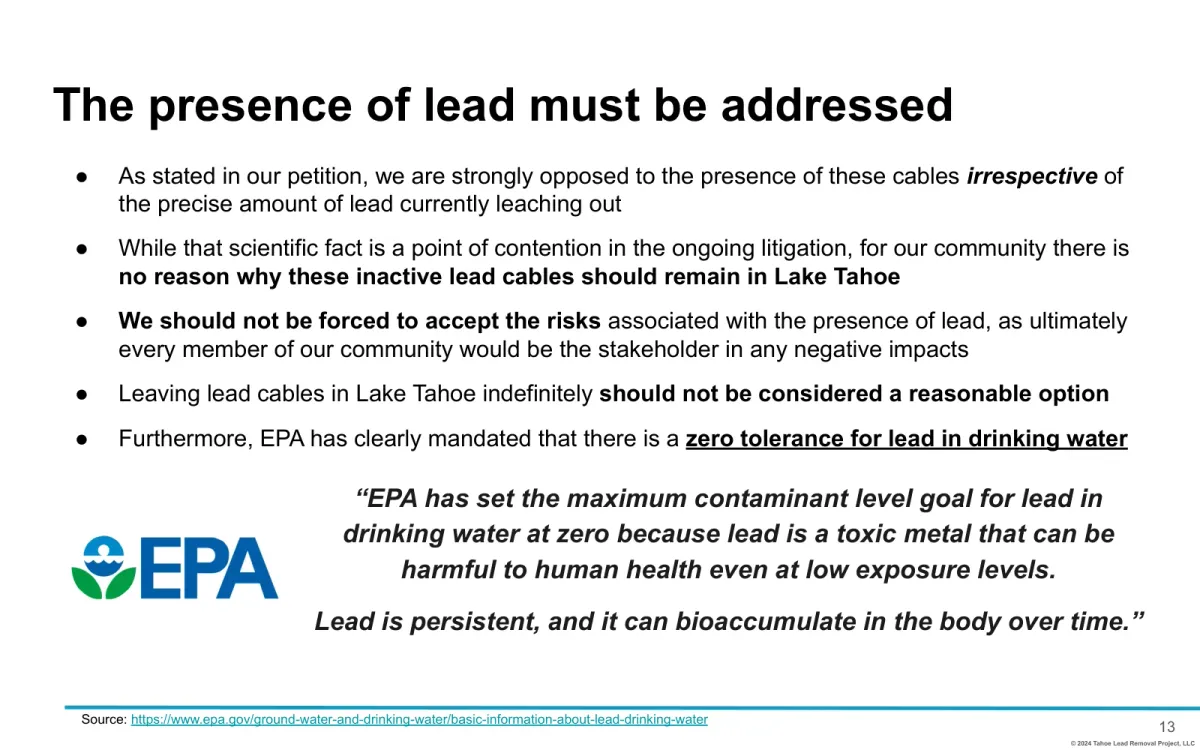
- As stated in our petition, we are strongly opposed to the presence of these cables irrespective of the precise amount of lead currently leaching out
- While that scientific fact is a point of contention in the ongoing litigation, for our community there is no reason why these inactive lead cables should remain in Lake Tahoe
- We should not be forced to accept the risks associated with the presence of lead, as ultimately every member of our community would be the stakeholder in any negative impacts
- Leaving lead cables in Lake Tahoe indefinitely should not be considered a reasonable option
- Furthermore, EPA has clearly mandated that there is a zero tolerance for lead in drinking water
“EPA has set the maximum contaminant level goal for lead in
drinking water at zero because lead is a toxic metal that can be
harmful to human health even at low exposure levels.
Lead is persistent, and it can bioaccumulate in the body over time.”
Source: https://www.epa.gov/ground-water-and-drinking-water/basic-information-about-lead-drinking-water
This situation is a burden of the past
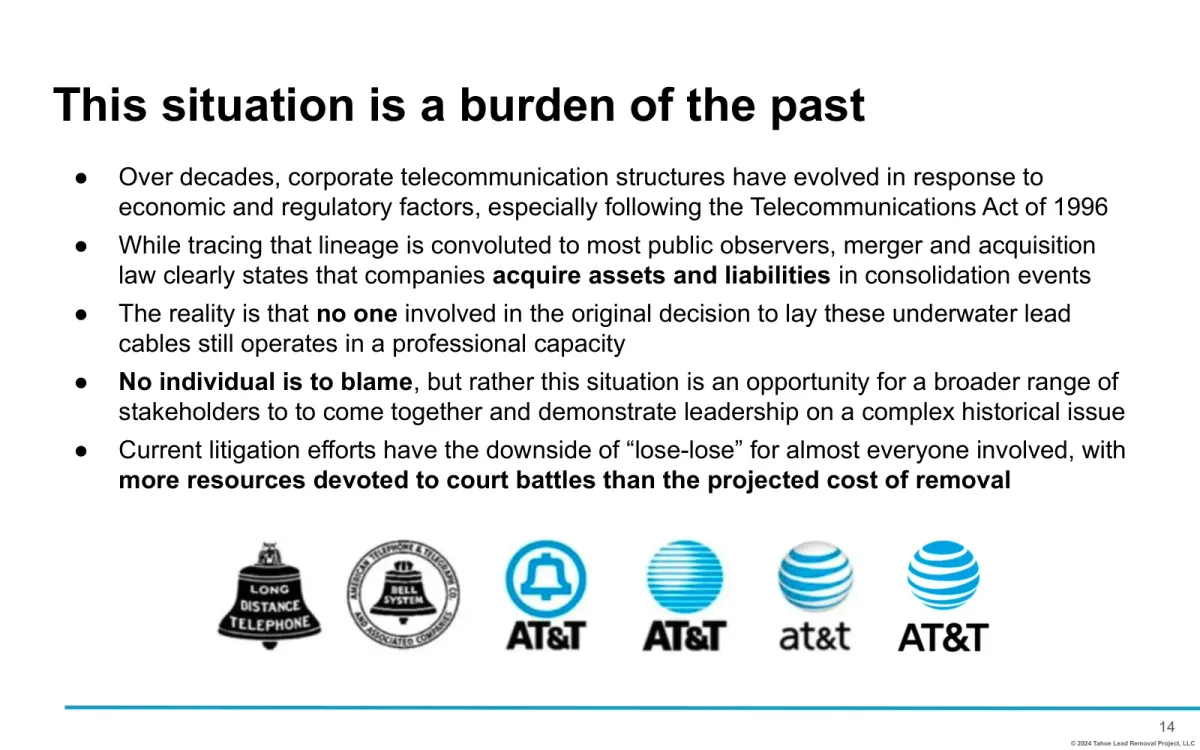
- Over decades, corporate telecommunication structures have evolved in response to economic and regulatory factors, especially following the Telecommunications Act of 1996
- While tracing that lineage is convoluted to most public observers, merger and acquisition law clearly states that companies acquireassets and liabilities in consolidation events
- The reality is that no one involved in the original decision to lay these underwater lead cables still operates in a professional capacity
- No individual is to blame, but rather this situation is an opportunity for a broader range of stakeholders to to come together and demonstrate leadership on a complex historical issue
- Current litigation efforts have the downside of “lose-lose” for almost everyone involved, with more resources devoted to court battles than the projected cost of removal
AT&T is neither villain nor at fault
- Unfortunately, the media has portrayed this situation in a divisive way that assigns blame to the telecommunication companies that may have unknowingly acquired legacy lead infrastructure
- While the telecom companies have the resources and know how to step up and demonstrate true leadership in sustainability by taking action - the reasons why they won’t are self evident
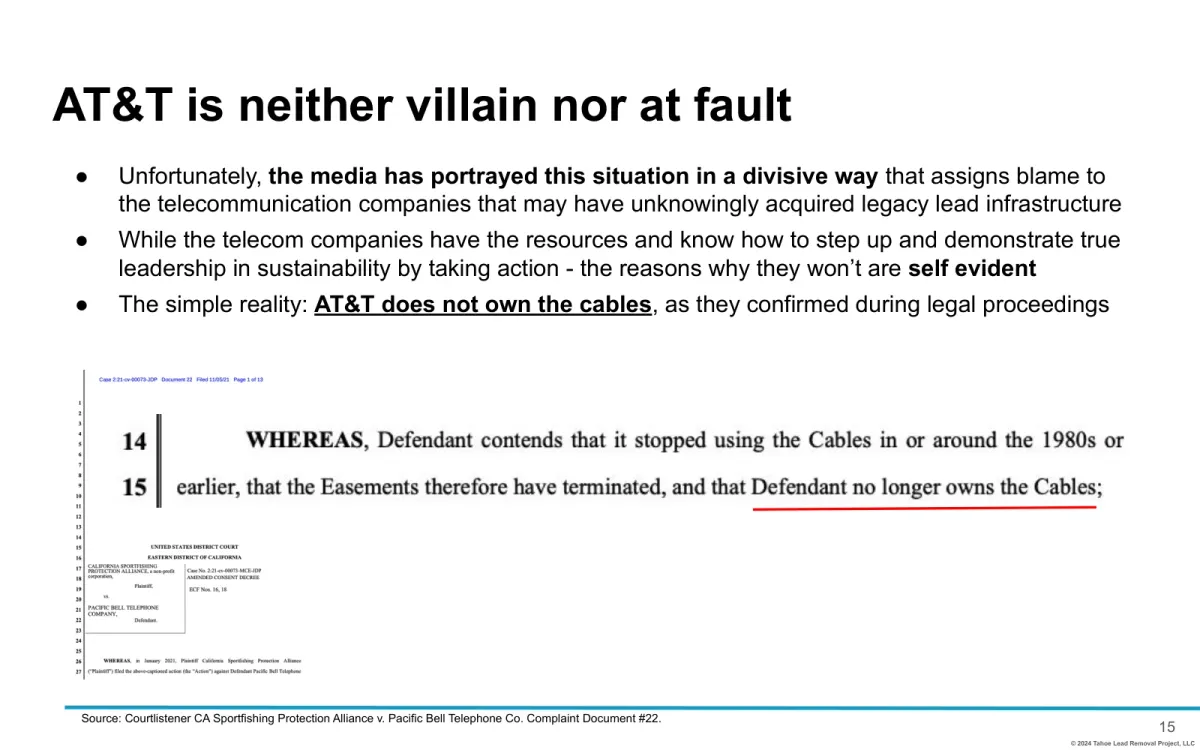
- The simple reality: AT&T does not own the cables, as they confirmed during legal proceedings
Source: Courtlistener CA Sportfishing Protection Alliance v. Pacific Bell Telephone Co. Complaint Document #22.
Removal shouldn’t be contingent on litigation ● We acknowledge that approving the removal of these cables while they’re under consideration in
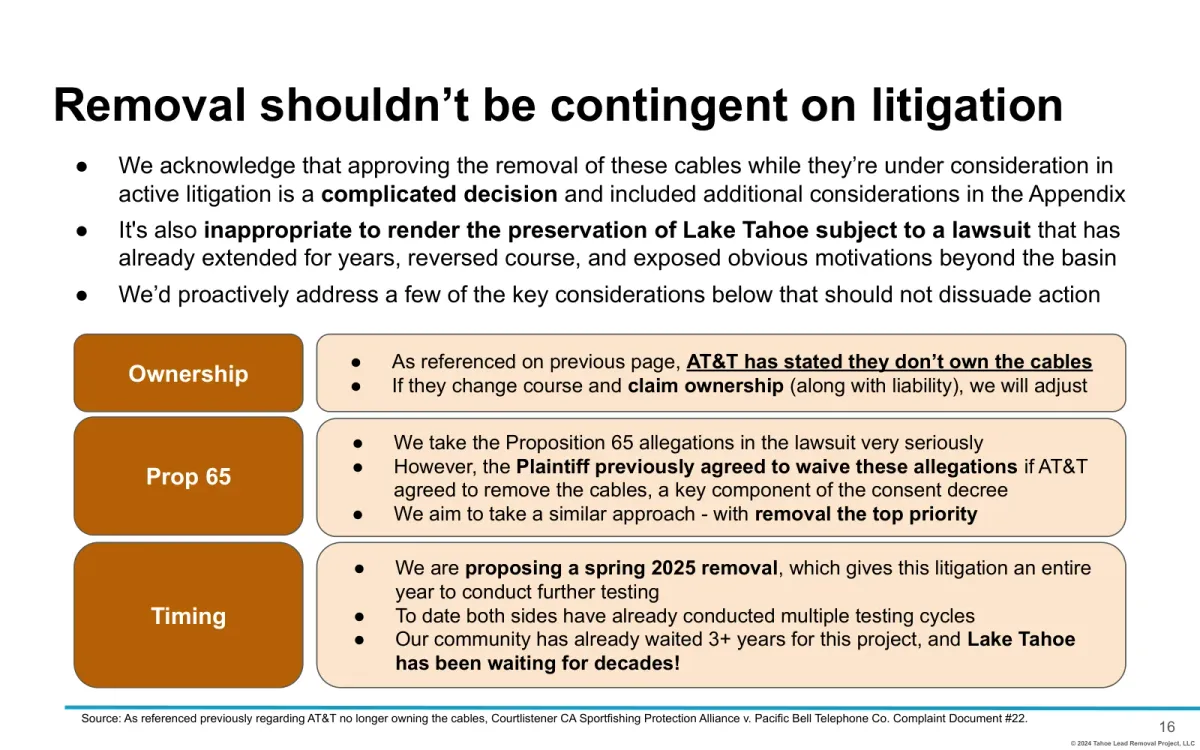
active litigation is a complicated decision and included additional considerations in the Appendix
- It's also inappropriate to render the preservation of Lake Tahoe subject to a lawsuit that has already extended for years, reversed course, and exposed obvious motivations beyond the basin
- We’d proactively address a few of the key considerations below that should not dissuade action
- As referenced on previous page, AT&T has stated they don’t own the cables
Ownership
- If they change course and claim ownership (along with liability), we will adjust
- We take the Proposition 65 allegations in the lawsuit very seriously
- However, the Plaintiff previously agreed to waive these allegations if AT&T
Prop 65
agreed to remove the cables, a key component of the consent decree
- We aim to take a similar approach - with removal the top priority
- We are proposing a spring 2025 removal, which gives this litigation an entire year to conduct further testing
Timing
- To date both sides have already conducted multiple testing cycles
- Our community has already waited 3+ years for this project, and Lake Tahoe has been waiting for decades!
Source: As referenced previously regarding AT&T no longer owning the cables, Courtlistener CA Sportfishing Protection Alliance v. Pacific Bell Telephone Co. Complaint Document #22.
3. Key Risks to Inaction
AT&T made their opinion on lead impacts clear
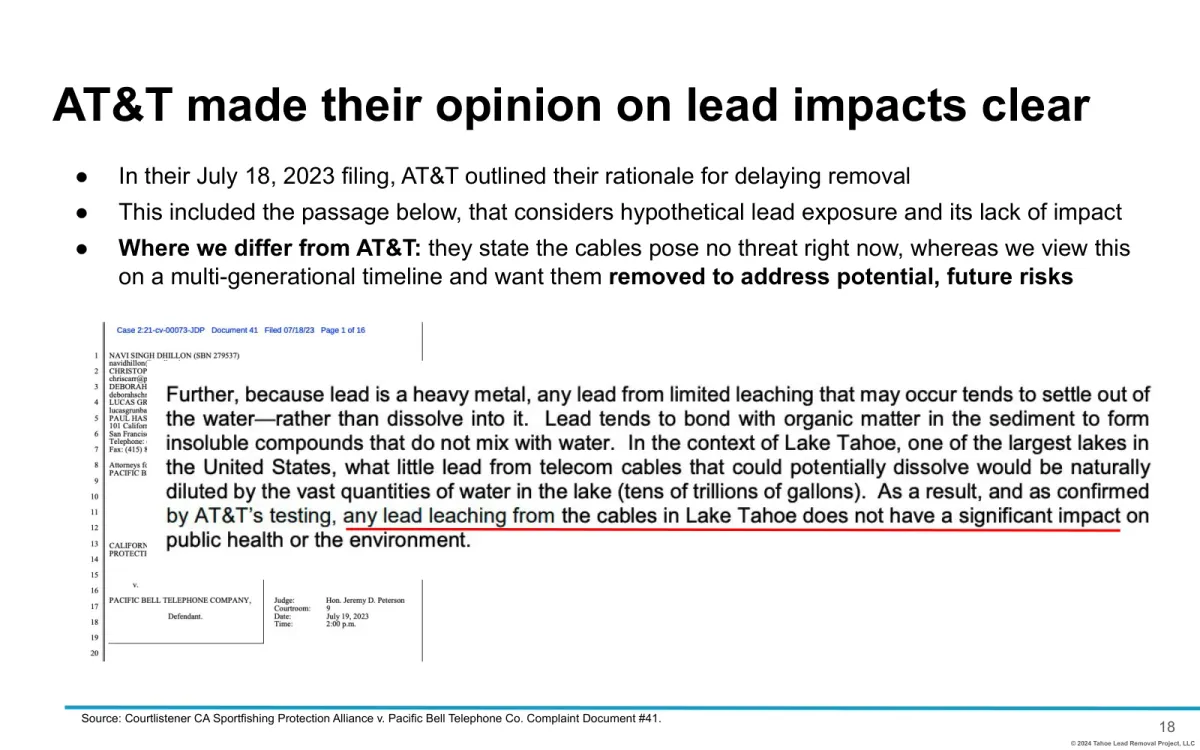
- In their July 18, 2023 filing, AT&T outlined their rationale for delaying removal
- This included the passage below, that considers hypothetical lead exposure and its lack of impact
- Where we differ from AT&T: they state the cables pose no threat right now, whereas we view this on a multi-generational timeline and want them removed to address potential, future risks
Source: Courtlistener CA Sportfishing Protection Alliance v. Pacific Bell Telephone Co. Complaint Document #41.
Key Risk: Erosion and deterioration on rocks
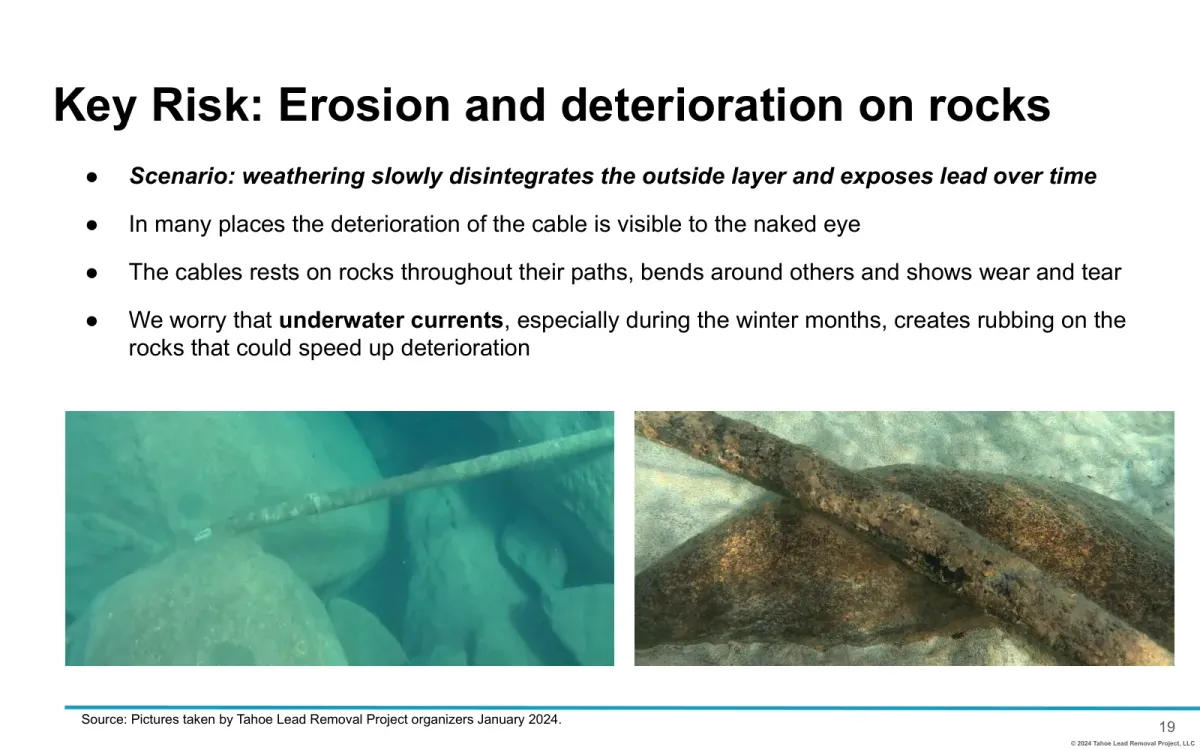
- Scenario: weathering slowly disintegrates the outside layer and exposes lead over time
- In many places the deterioration of the cable is visible to the naked eye
- The cables rests on rocks throughout their paths, bends around others and shows wear and tear
- We worry that underwater currents, especially during the winter months, creates rubbing on the rocks that could speed up deterioration
Source: Pictures taken by Tahoe Lead Removal Project organizers January 2024.
Key Risk: Potential impact to wildlife
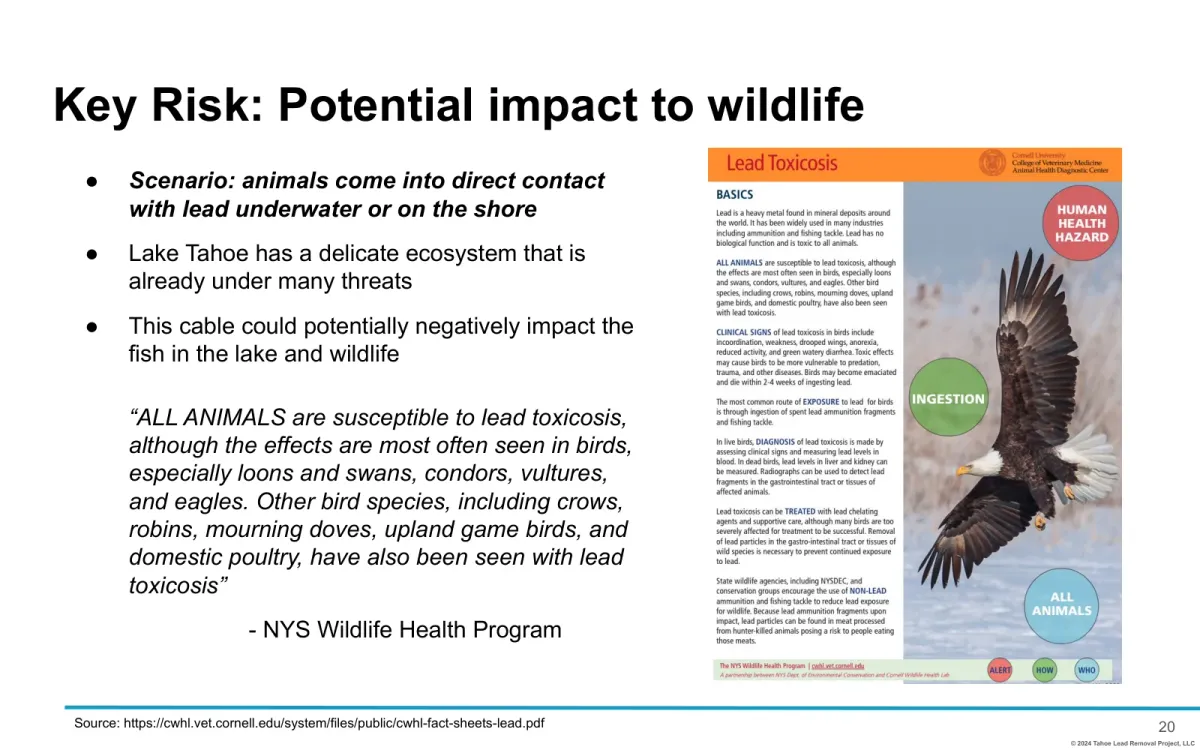
- Scenario: animals come into direct contact with lead underwater or on the shore
- Lake Tahoe has a delicate ecosystem that is already under many threats
- This cable could potentially negatively impact the fish in the lake and wildlife
“ALL ANIMALS are susceptible to lead toxicosis, although the effects are most often seen in birds, especially loons and swans, condors, vultures, and eagles. Other bird species, including crows, robins, mourning doves, upland game birds, and domestic poultry, have also been seen with lead toxicosis”
- NYS Wildlife Health Program
Source: https://cwhl.vet.cornell.edu/system/files/public/cwhl-fact-sheets-lead.pdf
Key Risk: Recreational incident or accident ● Scenario: Individuals unknowing come into contact
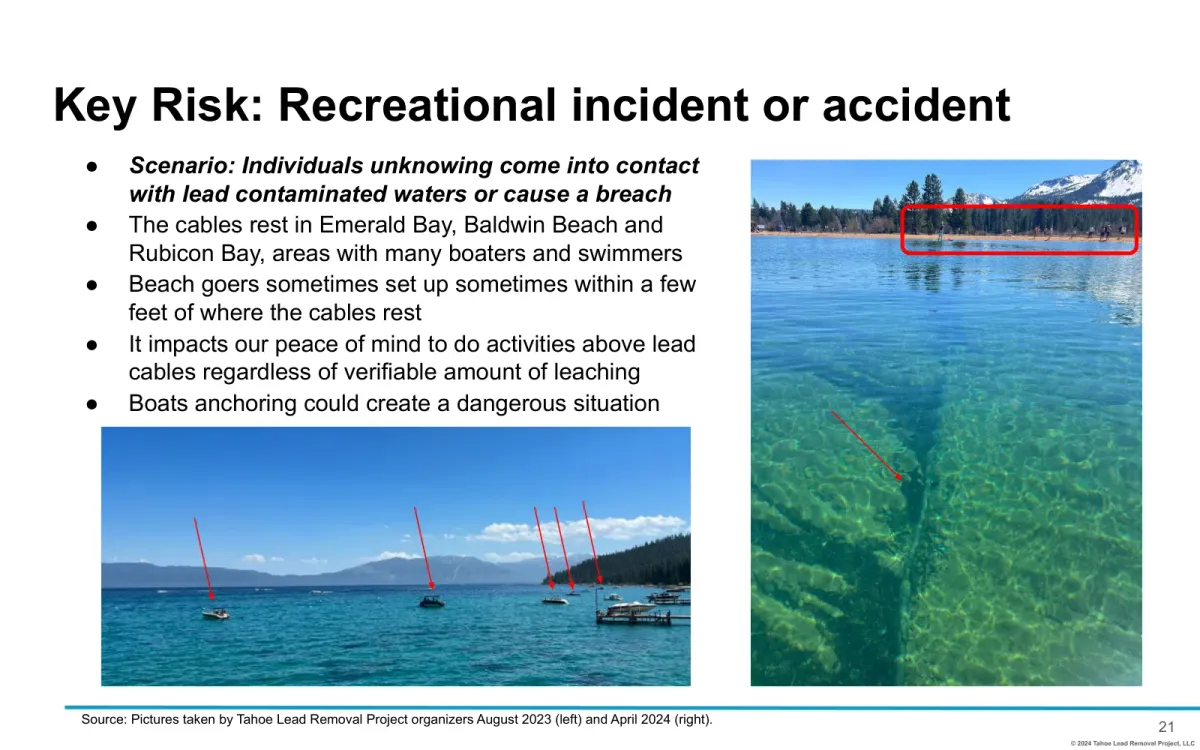
with lead contaminated waters or cause a breach
- The cables rest in Emerald Bay, Baldwin Beach and Rubicon Bay, areas with many boaters and swimmers
- Beach goers sometimes set up sometimes within a few feet of where the cables rest
- It impacts our peace of mind to do activities above lead cables regardless of verifiable amount of leaching
- Boats anchoring could create a dangerous situation
Source: Pictures taken by Tahoe Lead Removal Project organizers August 2023 (left) and April 2024 (right).
Key Risk: West Shore Fault
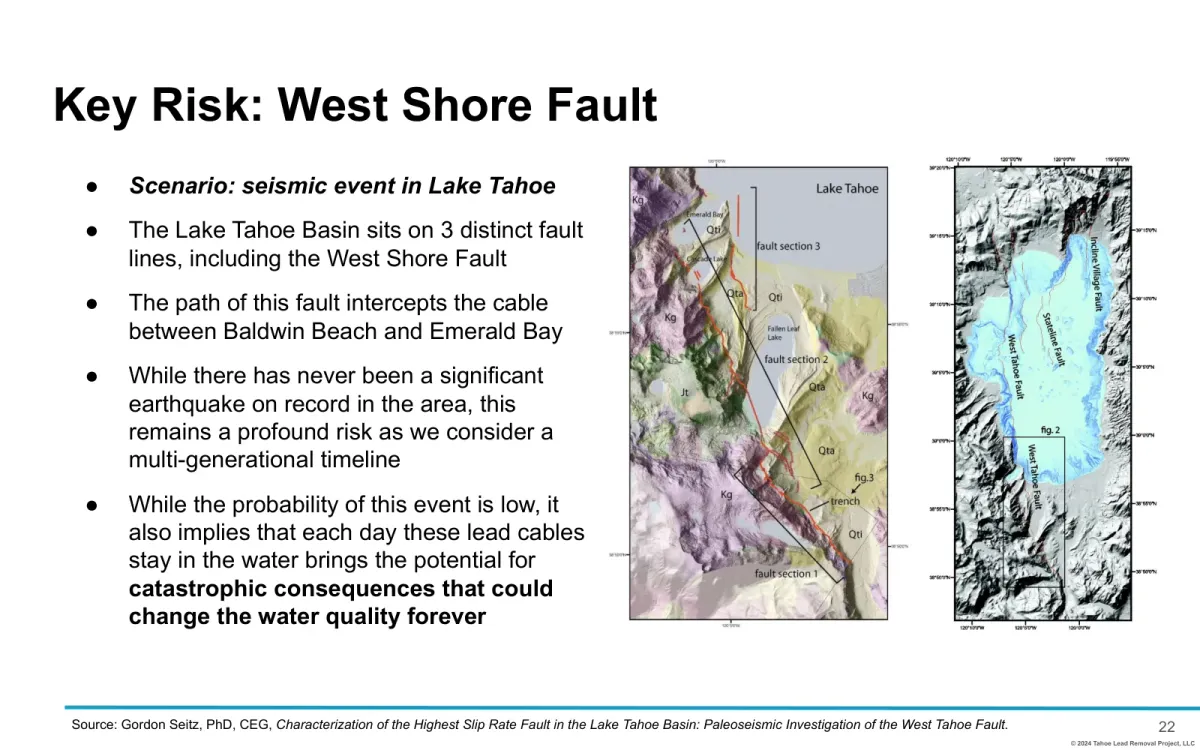
- Scenario: seismic event in Lake Tahoe
- The Lake Tahoe Basin sits on 3 distinct fault lines, including the West Shore Fault
- The path of this fault intercepts the cable between Baldwin Beach and Emerald Bay
- While there has never been a significant earthquake on record in the area, this remains a profound risk as we consider a multi-generational timeline
- While the probability of this event is low, it also implies that each day these lead cables stay in the water brings the potential for catastrophic consequences that could change the water quality forever
Source: Gordon Seitz, PhD, CEG, Characterization of the Highest Slip Rate Fault in the Lake Tahoe Basin: Paleoseismic Investigation of the West Tahoe Fault.
4. Our Approach to Removal
Our community effort
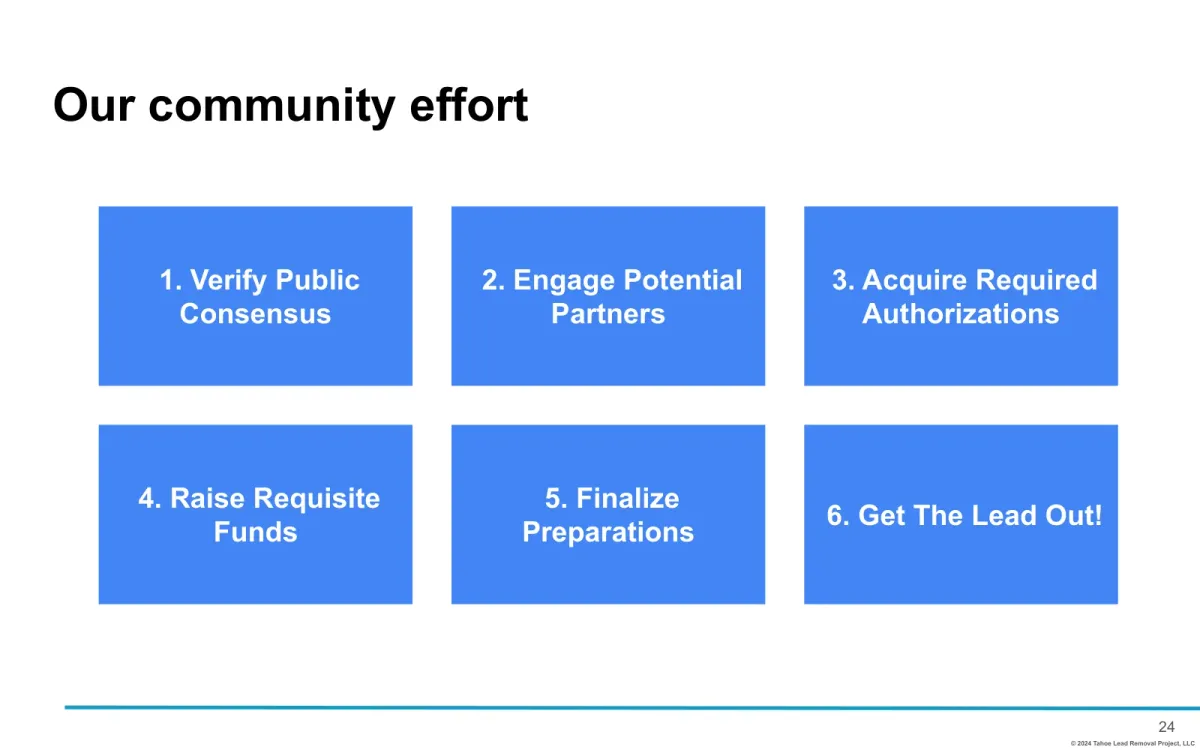
1. Verify Public
2. Engage Potential
Consensus
Partners
4. Raise Requisite
5. Finalize
Funds
Preparations
3. Acquire Required
Authorizations
6. Get The Lead Out!
Illustrative Project Timeline
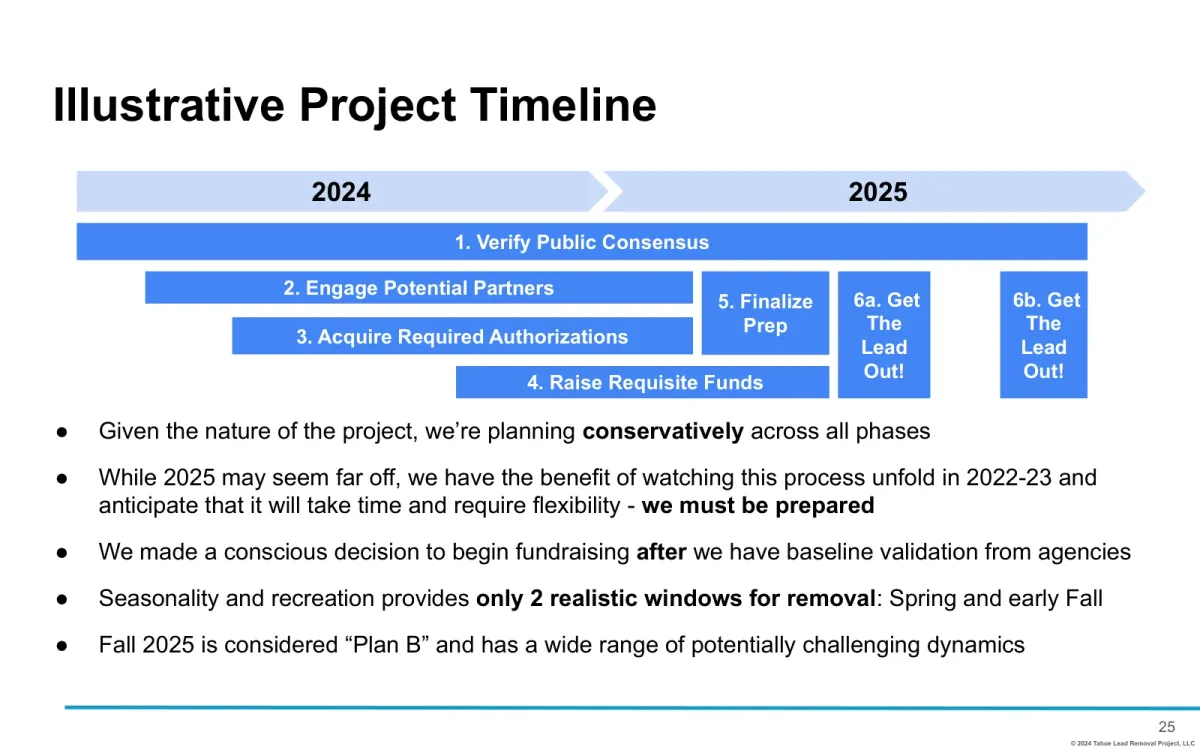
2024
1. Verify Public Consensus
2. Engage Potential Partners
3. Acquire Required Authorizations
4. Raise Requisite Funds
- Given the nature of the project, we’re planning conservatively across all phases
- While 2025 may seem far off, we have the benefit of watching this process unfold in 2022-23 and anticipate that it will take time and require flexibility - we must be prepared
- We made a conscious decision to begin fundraising after we have baseline validation from agencies
- Seasonality and recreation provides only 2 realistic windows for removal: Spring and early Fall
- Fall 2025 is considered “Plan B” and has a wide range of potentially challenging dynamics
2025
6a. Get
6b. Get
5. Finalize
The
The
Prep
Lead
Lead
Out!
Out!
We publicly launched our initiative this February
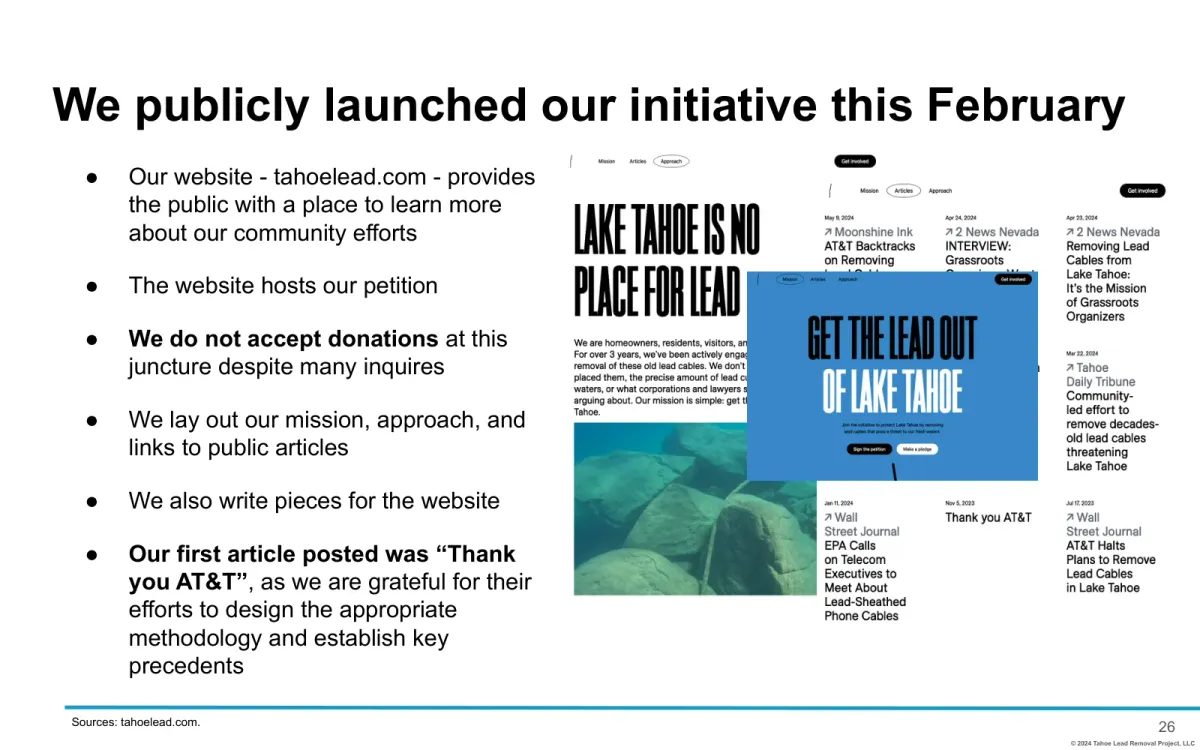
- Our website - tahoelead.com - provides the public with a place to learn more about our community efforts
- The website hosts our petition
- We do not accept donations at this juncture despite many inquires
- We lay out our mission, approach, and links to public articles
- We also write pieces for the website
- Our first article posted was “Thank you AT&T”, as we are grateful for their efforts to design the appropriate methodology and establish key precedents
Sources: tahoelead.com.
Petition signers in 2024
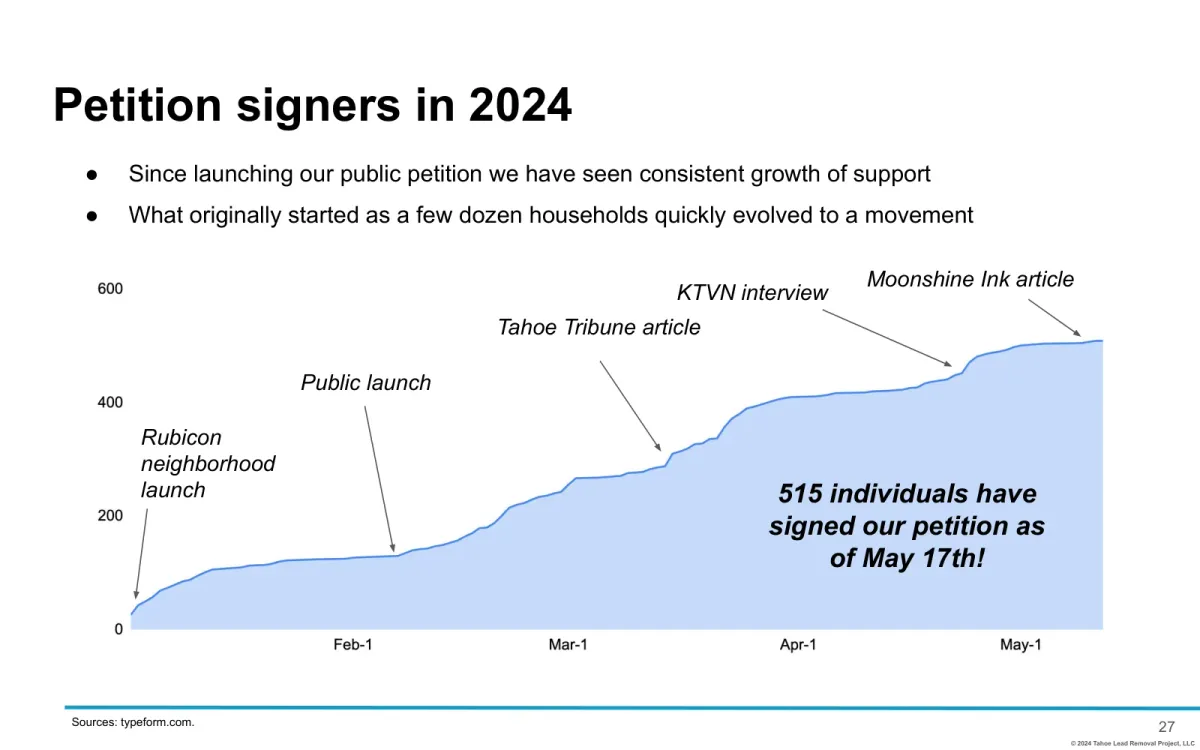
- Since launching our public petition we have seen consistent growth of support
- What originally started as a few dozen households quickly evolved to a movement
Tahoe Tribune article
Public launch
Rubicon neighborhood launch
Sources: typeform.com.
Moonshine Ink article
KTVN interview
515 individuals have
signed our petition as
of May 17th!
We are bringing a wide range of people together ● It’s been exciting to see such resounding support locally, as well as from frequent visitors
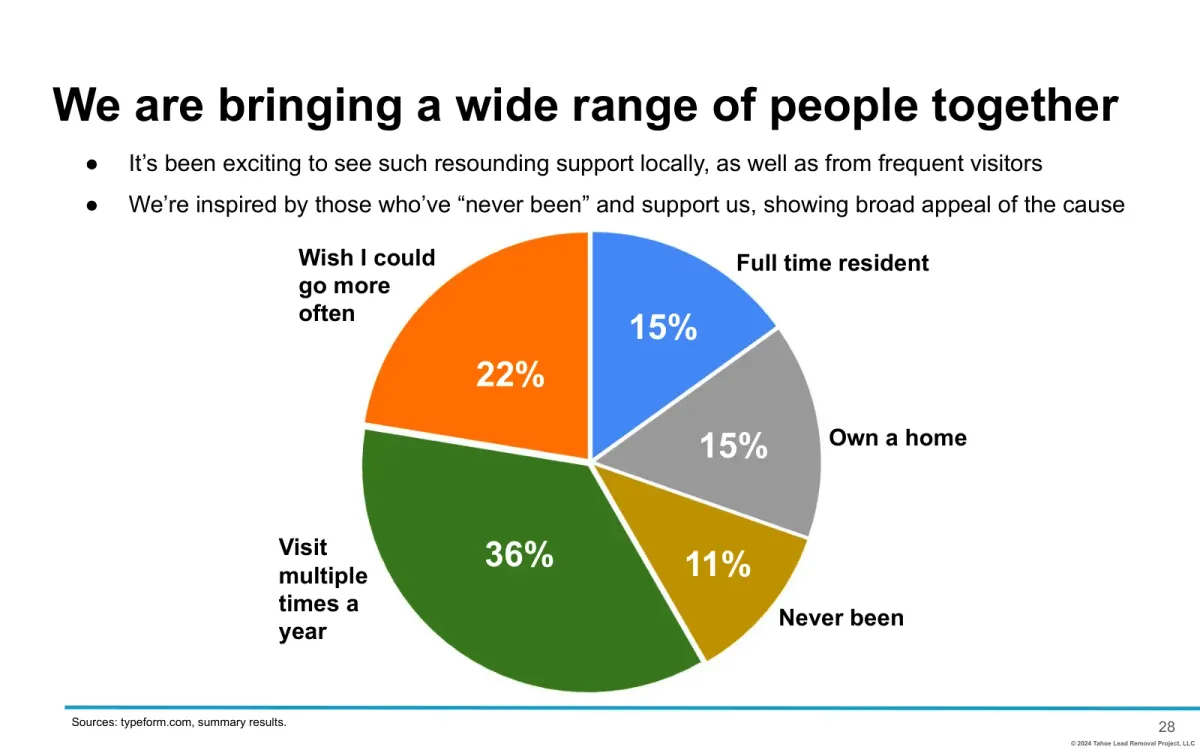
- We’re inspired by those who’ve “never been” and support us, showing broad appeal of the cause
Wish I could go more often
22%
Visit
36%
multiple times a year
Sources: typeform.com, summary results.
Full time resident
15%
Own a home
15%
11%
Never been
Public support has driven media interest
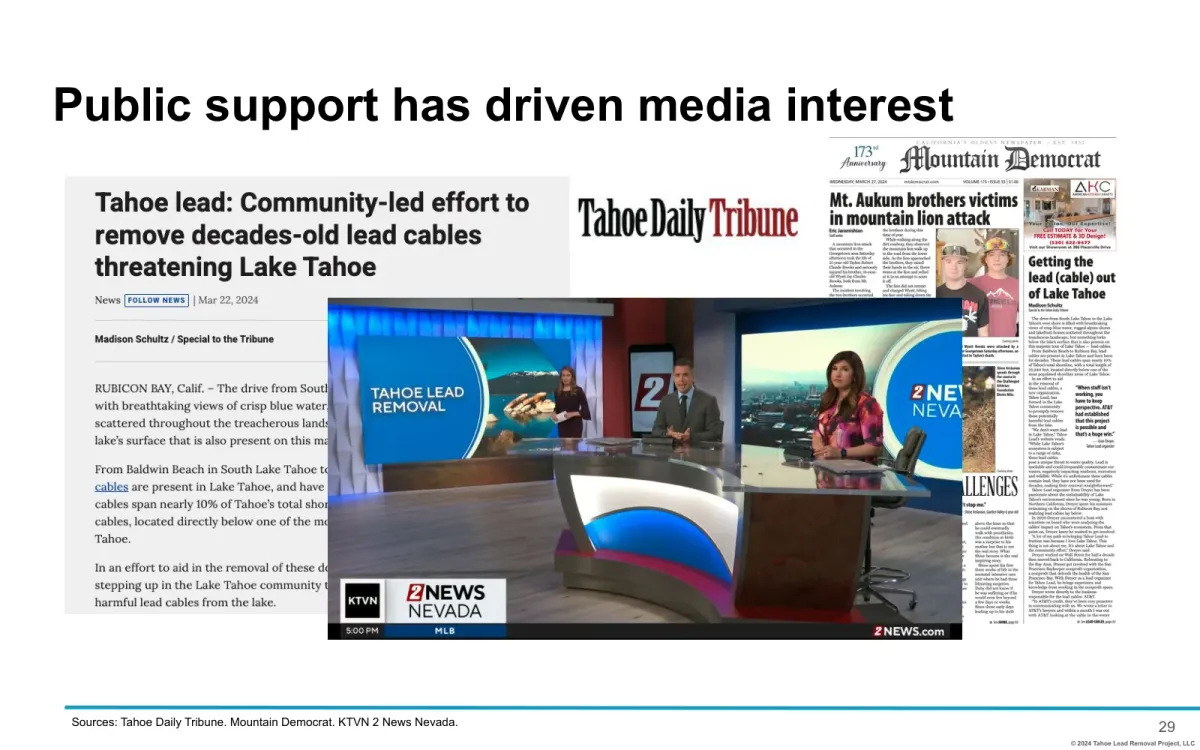
Sources: Tahoe Daily Tribune. Mountain Democrat. KTVN 2 News Nevada.
5. Project Execution & Partnerships
Capitalizing on existing momentum ● This project would be inconceivable without the time and resources expended by AT&T to date
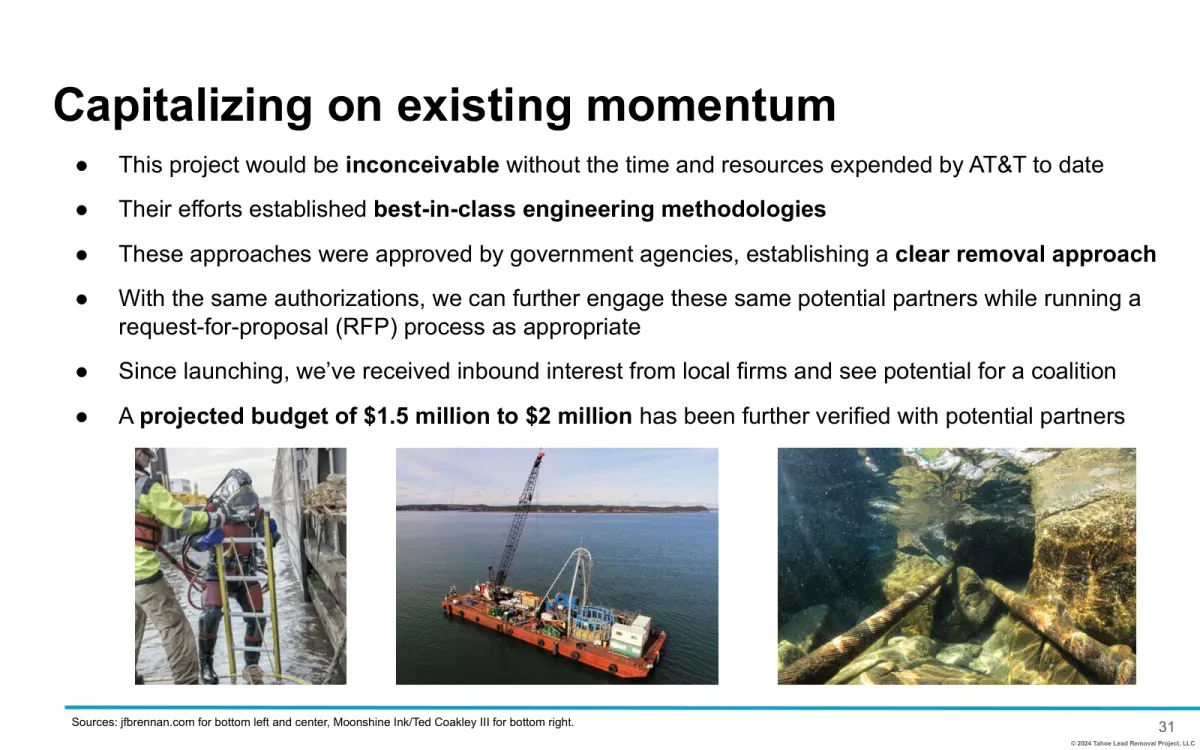
- Their efforts established best-in-class engineering methodologies
- These approaches were approved by government agencies, establishing a clear removal approach
- With the same authorizations, we can further engage these same potential partners while running a request-for-proposal (RFP) process as appropriate
- Since launching, we’ve received inbound interest from local firms and see potential for a coalition
- A projected budget of $1.5 million to $2 million has been further verified with potential partners
Sources: jfbrennan.com for bottom left and center, Moonshine Ink/Ted Coakley III for bottom right.
Execution Overview ● The appropriate approach to removal has been demystified over the past few years
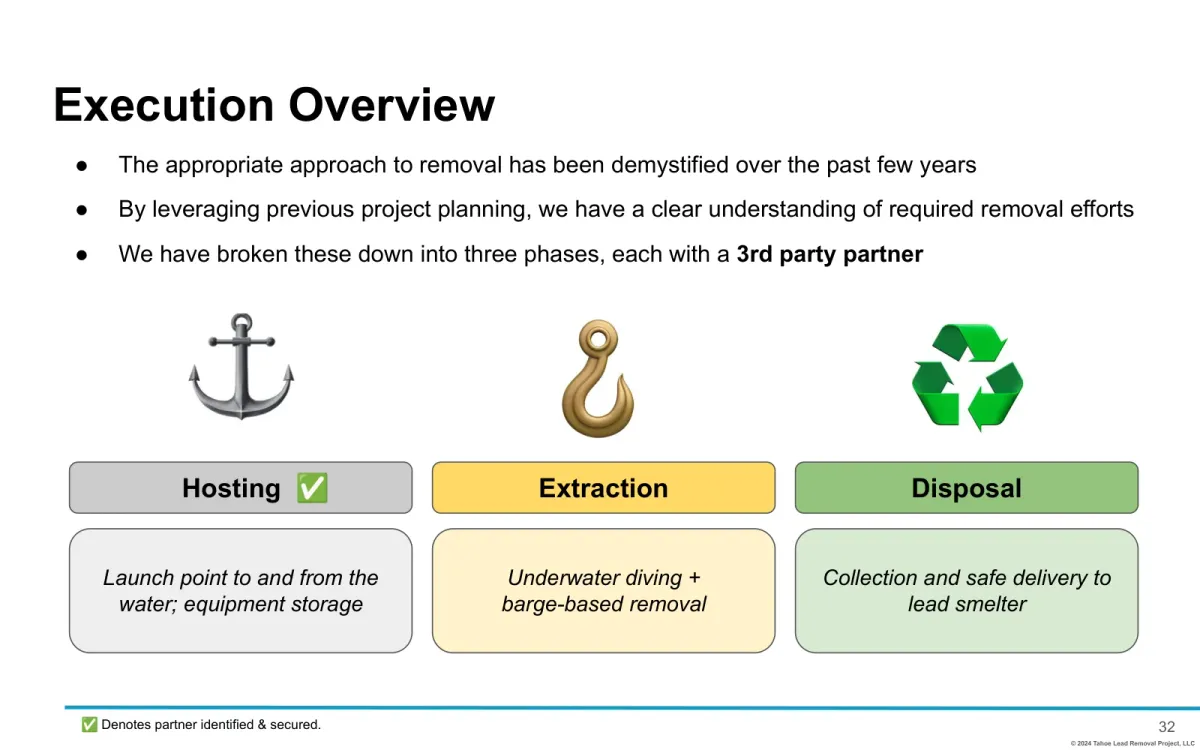
- By leveraging previous project planning, we have a clear understanding of required removal efforts
- We have broken these down into three phases, each with a 3rd party partner
Hosting ✅
Extraction
Launch point to and from the
Underwater diving +
water; equipment storage
barge-based removal
✅
Denotes partner identified & secured.
Disposal
Collection and safe delivery to
lead smelter
Location Planning
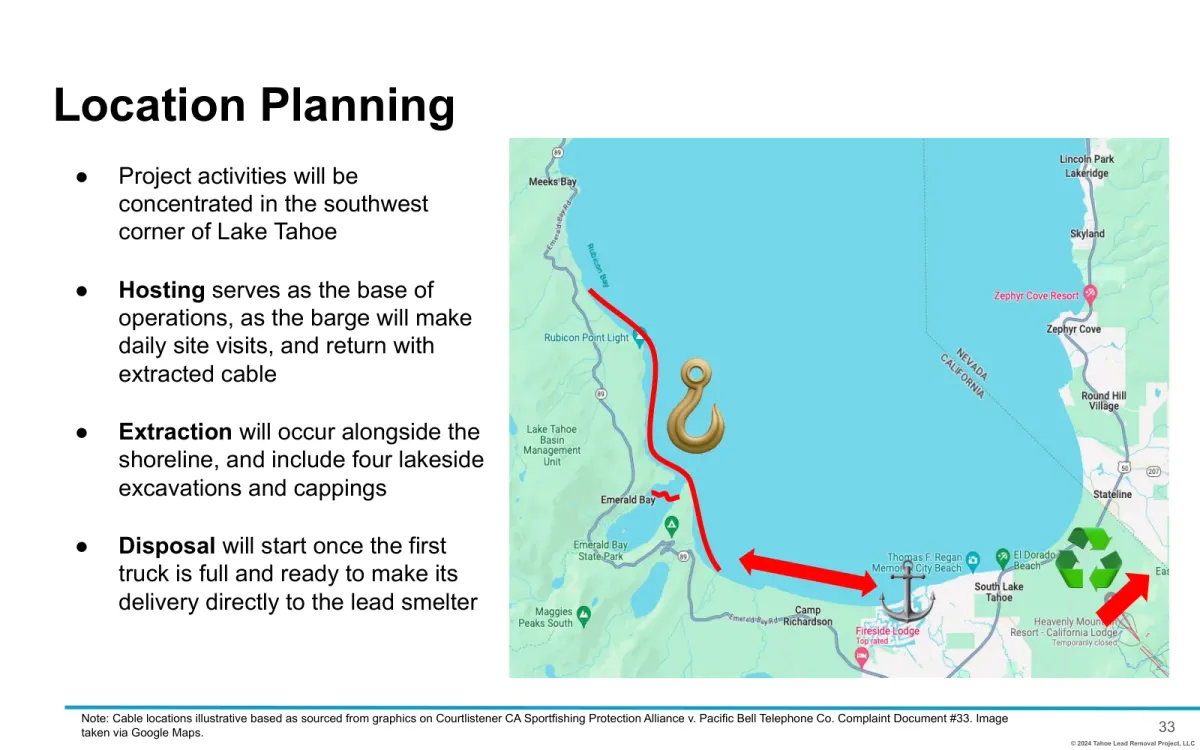
- Project activities will be concentrated in the southwest corner of Lake Tahoe
- Hosting serves as the base of operations, as the barge will make daily site visits, and return with extracted cable
- Extraction will occur alongside the shoreline, and include four lakeside excavations and cappings
- Disposal will start once the first truck is full and ready to make its delivery directly to the lead smelter
Note: Cable locations illustrative based as sourced from graphics on Courtlistener CA Sportfishing Protection Alliance v. Pacific Bell Telephone Co. Complaint Document #33. Image taken via Google Maps.
Confirmed Hosting Partner: Tahoe Keys Marina
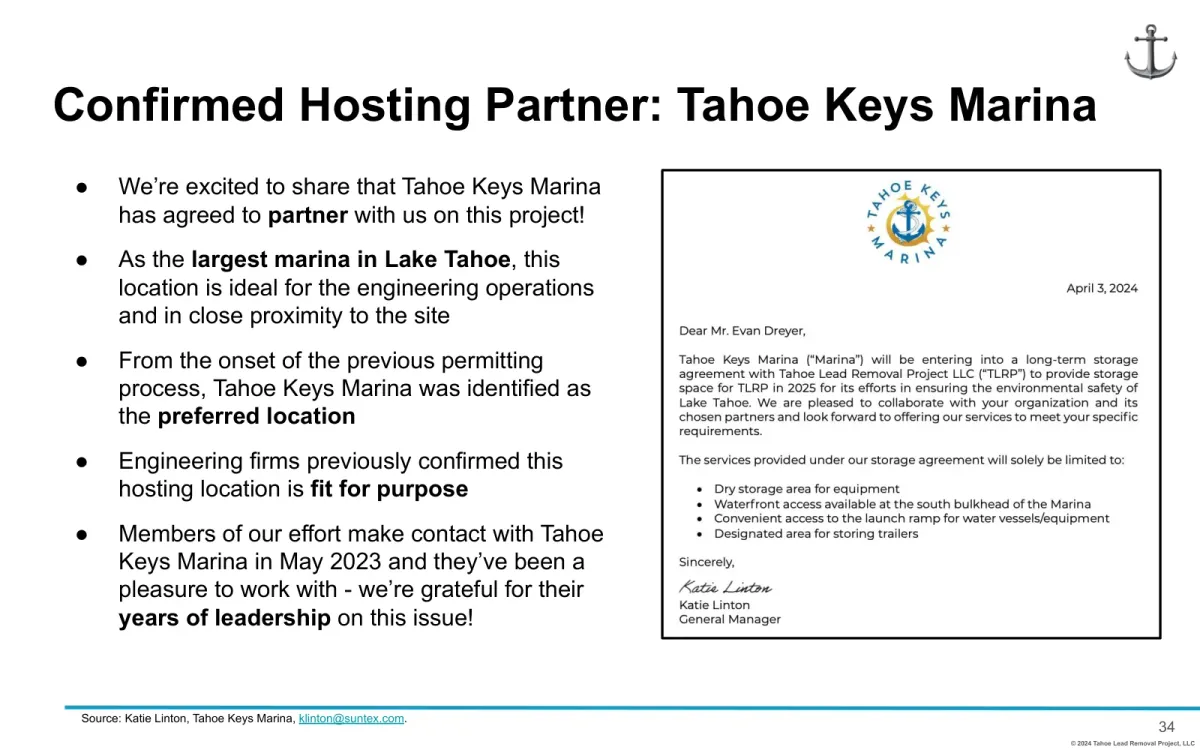
- We’re excited to share that Tahoe Keys Marina has agreed to partner with us on this project!
- As the largest marina in Lake Tahoe, this location is ideal for the engineering operations and in close proximity to the site
- From the onset of the previous permitting process, Tahoe Keys Marina was identified as the preferred location
- Engineering firms previously confirmed this hosting location is fit for purpose
- Members of our effort make contact with Tahoe Keys Marina in May 2023 and they’ve been a pleasure to work with - we’re grateful for their years of leadership on this issue!
Source: Katie Linton, Tahoe Keys Marina, klinton@suntex.com.
Extraction Overview ● While submarine cable removals are executed across the U.S., Lake Tahoe is a unique setting
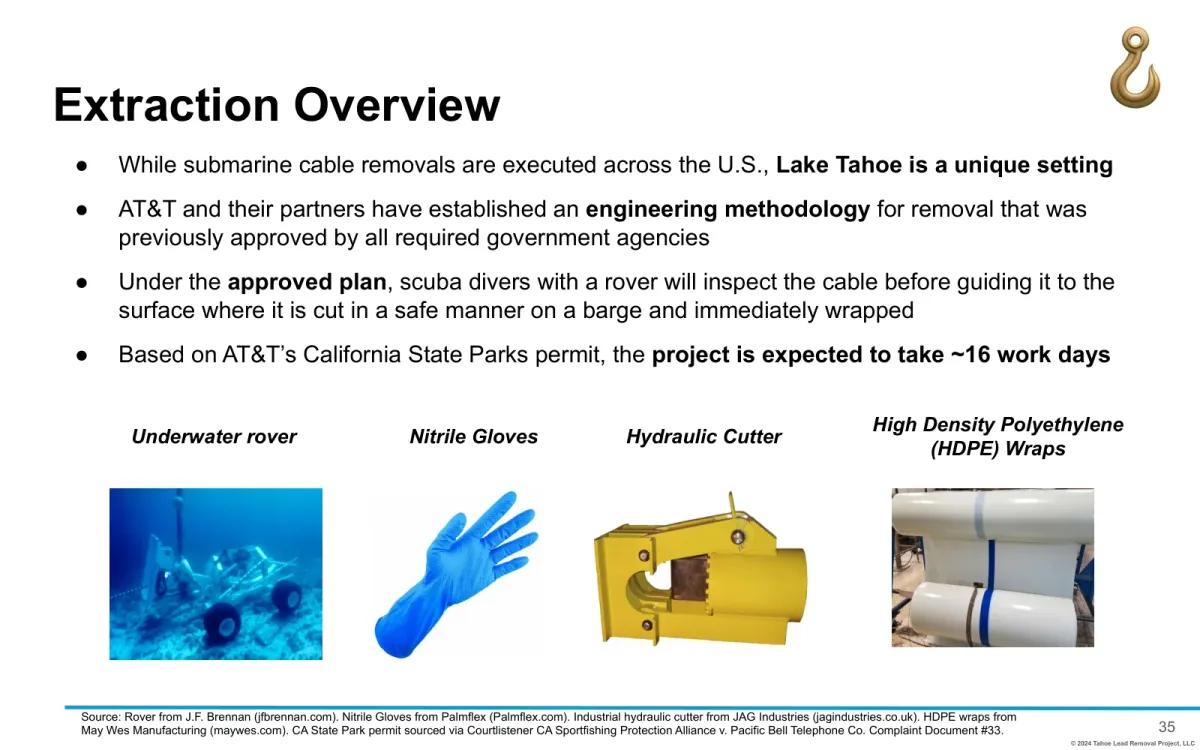
- AT&T and their partners have established an engineering methodology for removal that was previously approved by all required government agencies
- Under the approved plan, scuba divers with a rover will inspect the cable before guiding it to the surface where it is cut in a safe manner on a barge and immediately wrapped
- Based on AT&T’s California State Parks permit, the project is expected to take ~16 work days
Underwater rover
Nitrile Gloves
Source: Rover from J.F. Brennan (jfbrennan.com). Nitrile Gloves from Palmflex (Palmflex.com). Industrial hydraulic cutter from JAG Industries (jagindustries.co.uk). HDPE wraps from
May Wes Manufacturing (maywes.com). CA State Park permit sourced via Courtlistener CA Sportfishing Protection Alliance v. Pacific Bell Telephone Co. Complaint Document #33.
High Density Polyethylene
Hydraulic Cutter
(HDPE) Wraps
Extraction Method Cable is cut into sections aboard
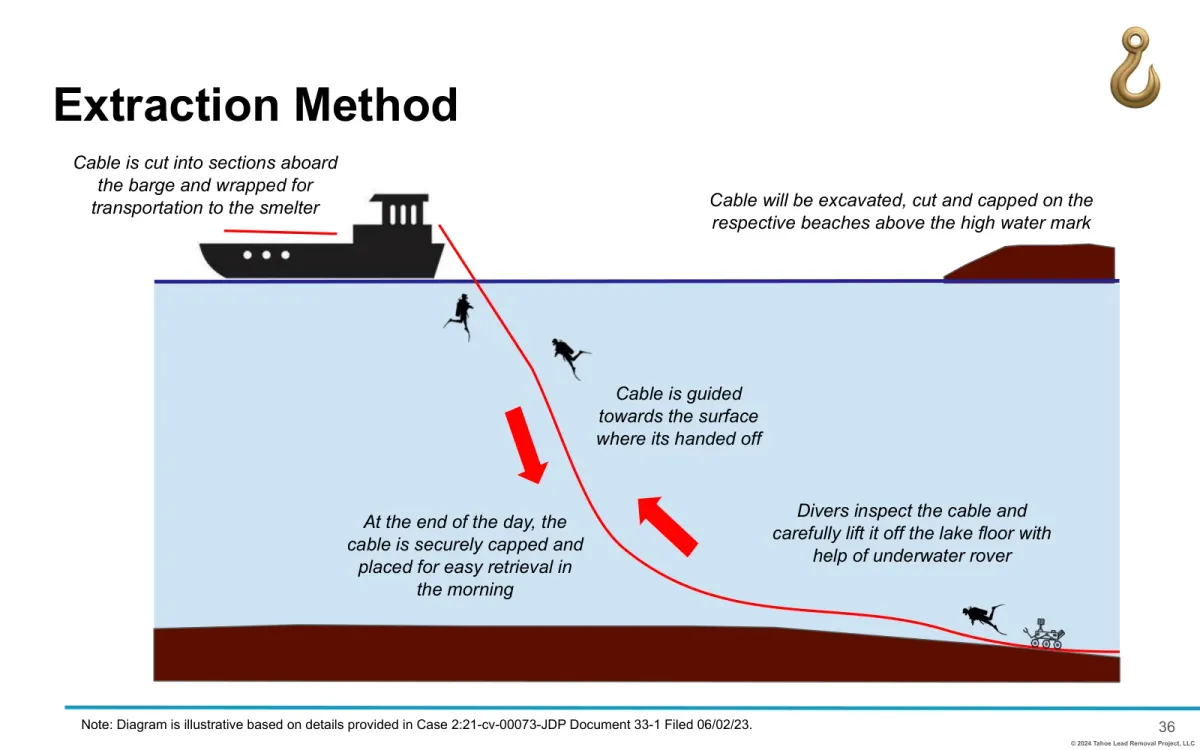
the barge and wrapped for transportation to the smelter
towards the surface where its handed off
At the end of the day, the
cable is securely capped and
placed for easy retrieval in
the morning
Note: Diagram is illustrative based on details provided in Case 2:21-cv-00073-JDP Document 33-1 Filed 06/02/23.
Cable will be excavated, cut and capped on the respective beaches above the high water mark
Cable is guided
Divers inspect the cable and
carefully lift it off the lake floor with
help of underwater rover
Preferred Partner: J.F. Brennan ● One of AT&T’s greatest contributions to the effort
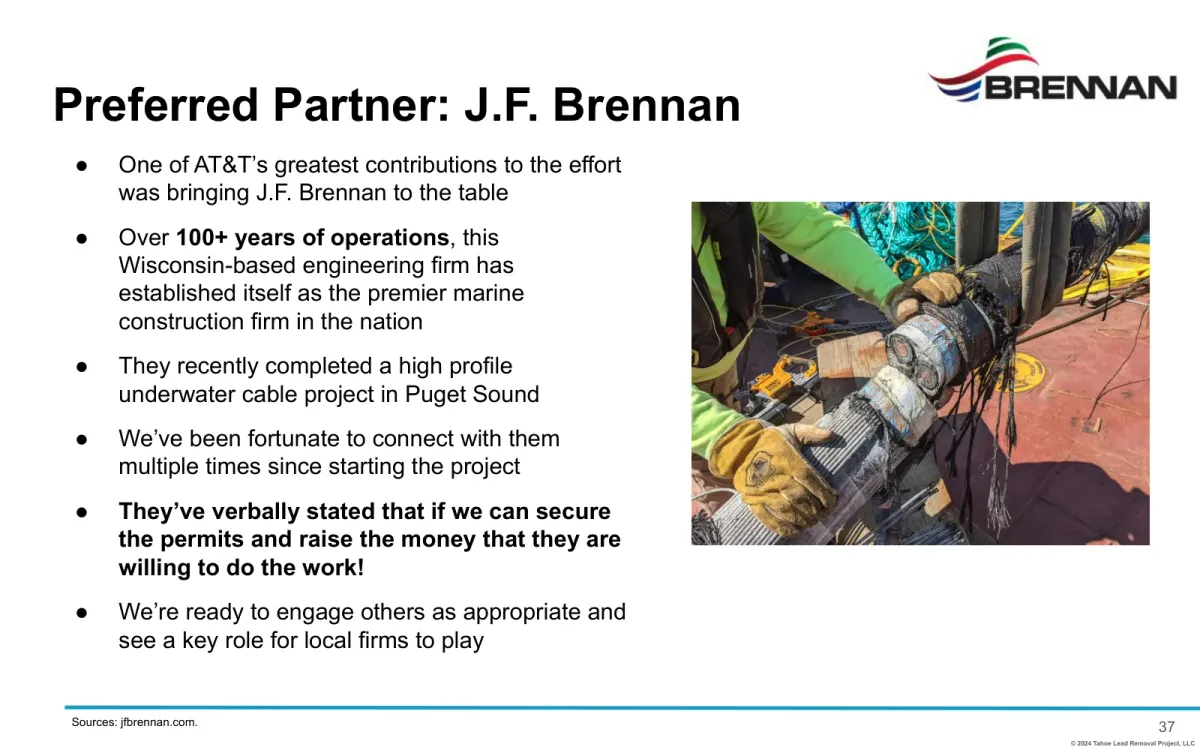
was bringing J.F. Brennan to the table
- Over 100+ years of operations, this Wisconsin-based engineering firm has established itself as the premier marine construction firm in the nation
- They recently completed a high profile underwater cable project in Puget Sound
- We’ve been fortunate to connect with them multiple times since starting the project
- They’ve verbally stated that if we can secure the permits and raise the money that they are willing to do the work!
- We’re ready to engage others as appropriate and see a key role for local firms to play
Sources: jfbrennan.com.
Disposal ● At its core, we are executing a big recycling project
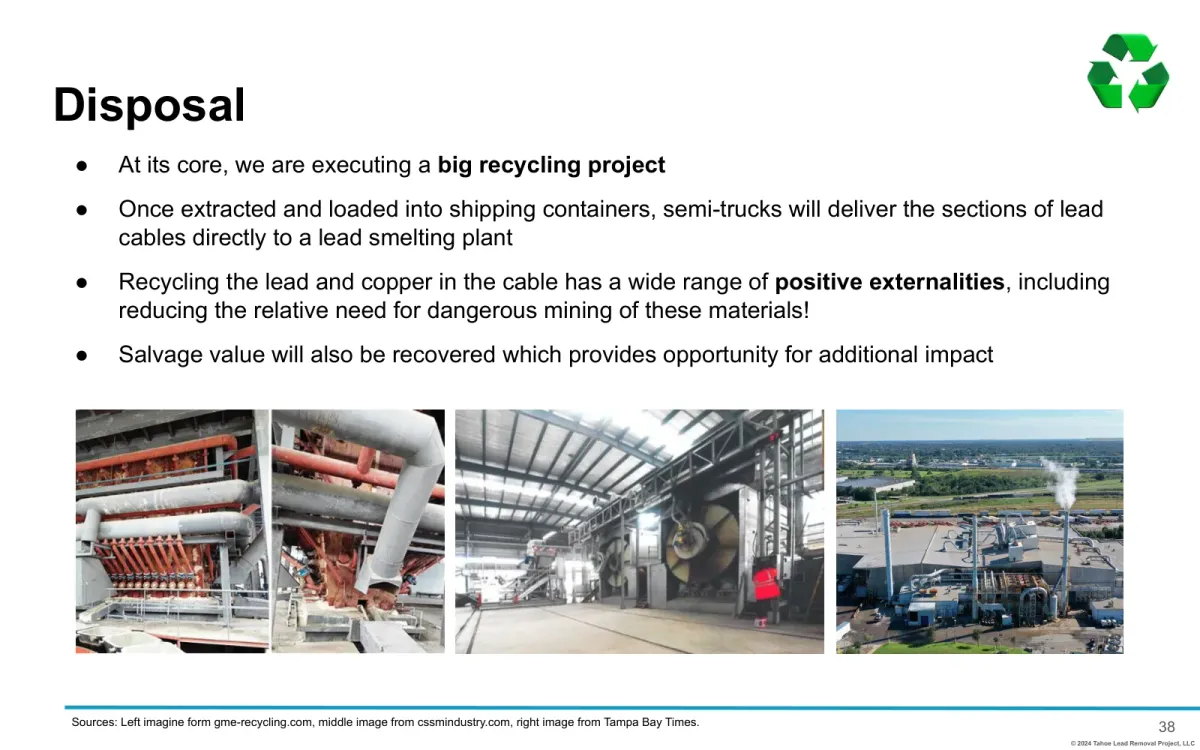
- Once extracted and loaded into shipping containers, semi-trucks will deliver the sections of lead cables directly to a lead smelting plant
- Recycling the lead and copper in the cable has a wide range of positive externalities, including reducing the relative need for dangerous mining of these materials!
- Salvage value will also be recovered which provides opportunity for additional impact
Sources: Left imagine form gme-recycling.com, middle image from cssmindustry.com, right image from Tampa Bay Times.
Cost anticipation & approach to fundraising ● As part of the consent decree, AT&T agreed to a conservative amount of up to $1,500,000 for the
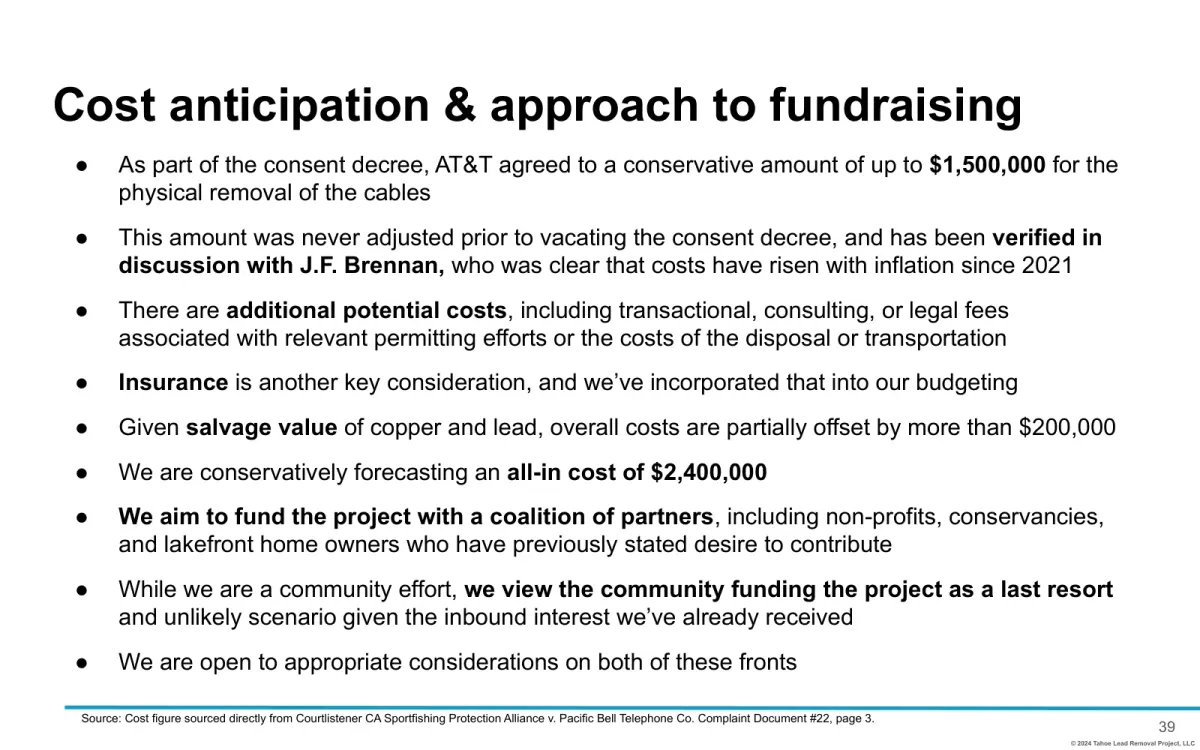
physical removal of the cables
- This amount was never adjusted prior to vacating the consent decree, and has been verified in discussion with J.F. Brennan, who was clear that costs have risen with inflation since 2021
- There are additional potential costs, including transactional, consulting, or legal fees associated with relevant permitting efforts or the costs of the disposal or transportation
- Insurance is another key consideration, and we’ve incorporated that into our budgeting
- Given salvage value of copper and lead, overall costs are partially offset by more than $200,000
- We are conservatively forecasting an all-in cost of $2,400,000
- We aim to fund the project with a coalition of partners, including non-profits, conservancies, and lakefront home owners who have previously stated desire to contribute
- While we are a community effort, we view the community funding the project as a last resort and unlikely scenario given the inbound interest we’ve already received
- We are open to appropriate considerations on both of these fronts
Source: Cost figure sourced directly from Courtlistener CA Sportfishing Protection Alliance v. Pacific Bell Telephone Co. Complaint Document #22, page 3.
7. Initiating Permitting Process
Permitting Precedents
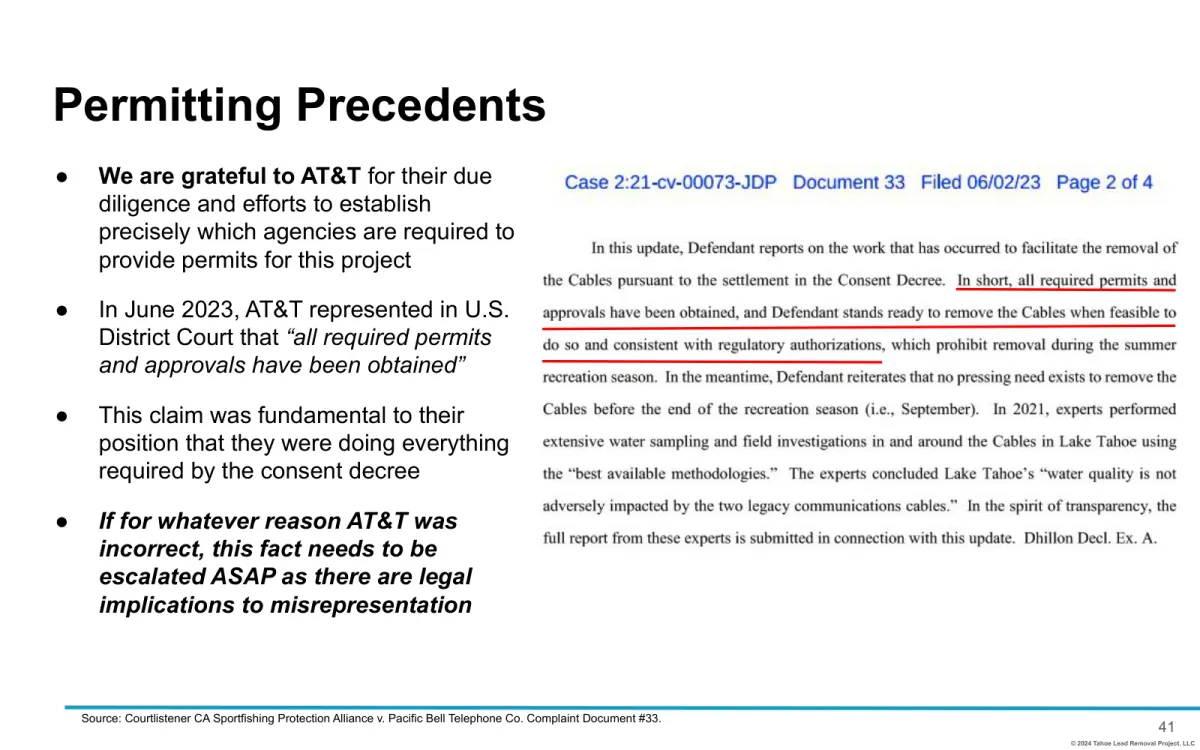
- We are grateful to AT&T for their due diligence and efforts to establish precisely which agencies are required to provide permits for this project
- In June 2023, AT&T represented in U.S. District Court that “all required permits and approvals have been obtained”
- This claim was fundamental to their position that they were doing everything required by the consent decree
- If for whatever reason AT&T was incorrect, this fact needs to be escalated ASAP as there are legal implications to misrepresentation
Source: Courtlistener CA Sportfishing Protection Alliance v. Pacific Bell Telephone Co. Complaint Document #33.
Authorizations Required
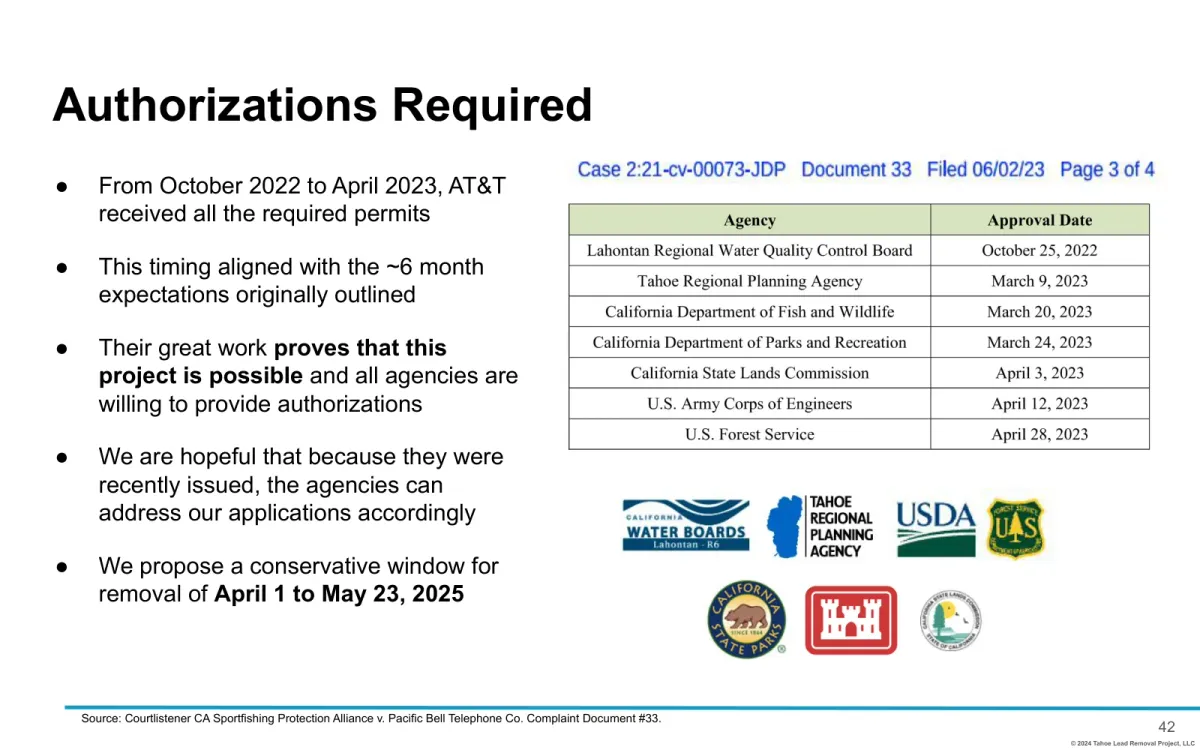
- From October 2022 to April 2023, AT&T received all the required permits
- This timing aligned with the ~6 month expectations originally outlined
- Their great work proves that this project is possible and all agencies are willing to provide authorizations
- We are hopeful that because they were recently issued, the agencies can address our applications accordingly
- We propose a conservative window for removal of April 1 to May 23, 2025
Source: Courtlistener CA Sportfishing Protection Alliance v. Pacific Bell Telephone Co. Complaint Document #33.
Points of contact
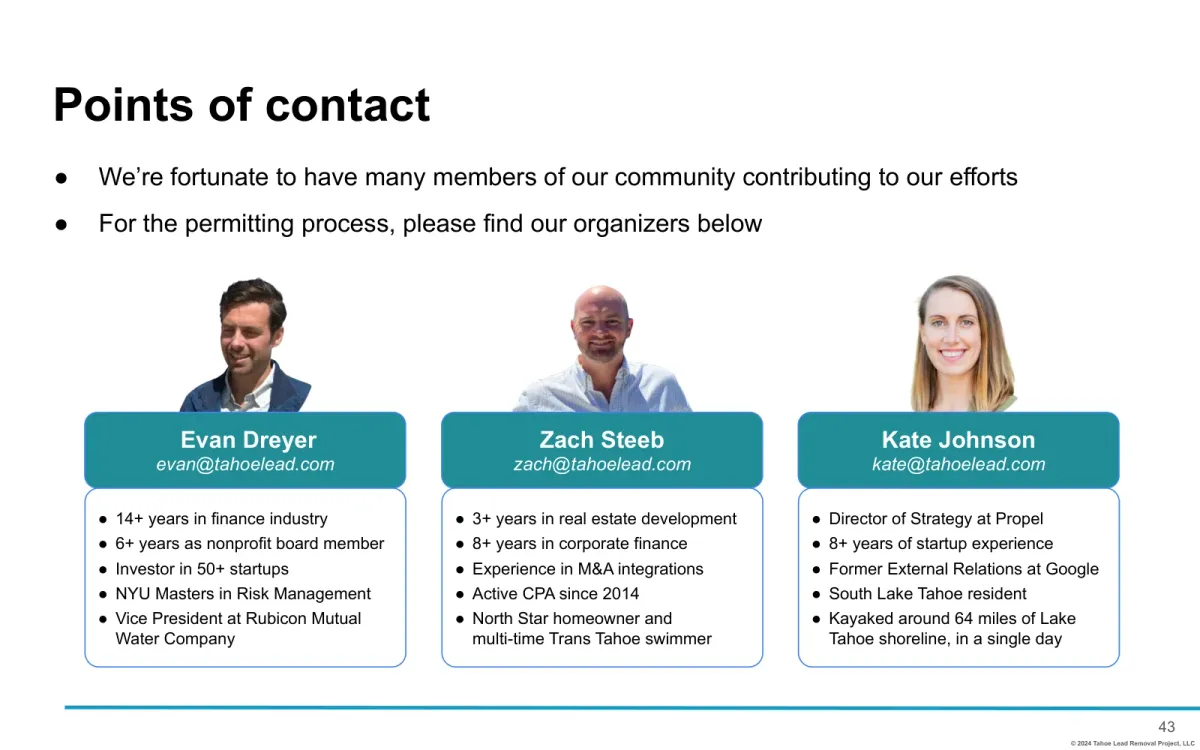
- We’re fortunate to have many members of our community contributing to our efforts
- For the permitting process, please find our organizers below
Evan Dreyer
Zach Steeb
evan@tahoelead.com
zach@tahoelead.com
●14+ years in finance industry
●3+ years in real estate development
●6+ years as nonprofit board member
●8+ years in corporate finance
●Investor in 50+ startups
●Experience in M&A integrations
●NYU Masters in Risk Management
●Active CPA since 2014
●Vice President at Rubicon Mutual
●North Star homeowner and
Water Company
multi-time Trans Tahoe swimmer
Kate Johnson
kate@tahoelead.com
●Director of Strategy at Propel ●8+ years of startup experience ●Former External Relations at Google ●South Lake Tahoe resident ●Kayaked around 64 miles of Lake
Tahoe shoreline, in a single day
In closing
- While this situation has created significant consternation in our community over the past 4 years, we are excited that there is a direct path to removal
- Lake Tahoe is worth preserving if there is any risk of irreversible negative impact
- All involved parties have previously agreed in various forms that these lead cables not only should be removed but can be removed
- We aim to organize the same project, this time driven by our community and not a corporation under threat of legal ramifications
- We are grateful for your consideration and partnership, and hope we can come together to make something special happen for Lake Tahoe
- Let’s get the lead out!
Appendix
A. Timeline of Events
Timeline of key events
2020
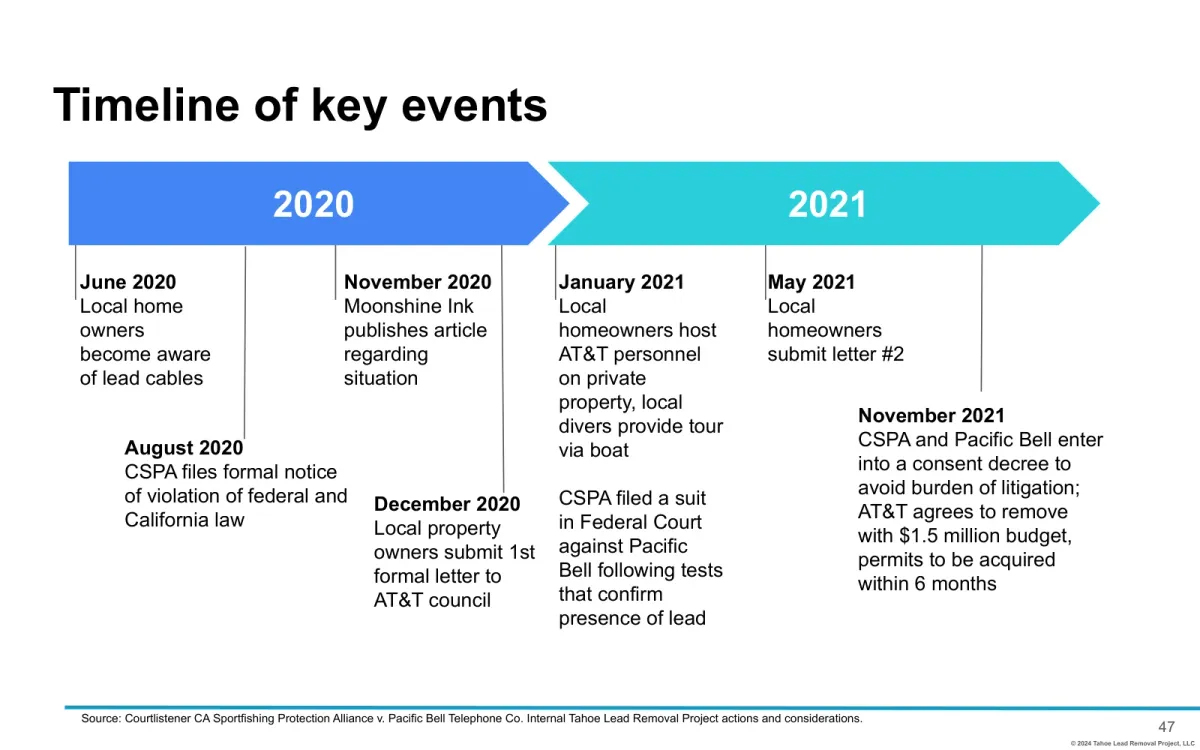
June 2020
November 2020
January 2021
Local home
Moonshine Ink
Local
owners
publishes article
homeowners host
become aware
regarding
AT&T personnel
of lead cables
situation
on private property, local divers provide tour
August 2020
via boat
CSPA files formal notice of violation of federal and
CSPA filed a suit
December 2020
California law
in Federal Court
Local property
against Pacific
owners submit 1st
Bell following tests
formal letter to
that confirm
AT&T council
presence of lead
Source: Courtlistener CA Sportfishing Protection Alliance v. Pacific Bell Telephone Co. Internal Tahoe Lead Removal Project actions and considerations.
2021
May 2021 Local homeowners submit letter #2
November 2021 CSPA and Pacific Bell enter into a consent decree to avoid burden of litigation; AT&T agrees to remove with $1.5 million budget, permits to be acquired within 6 months
Timeline of key events
2022
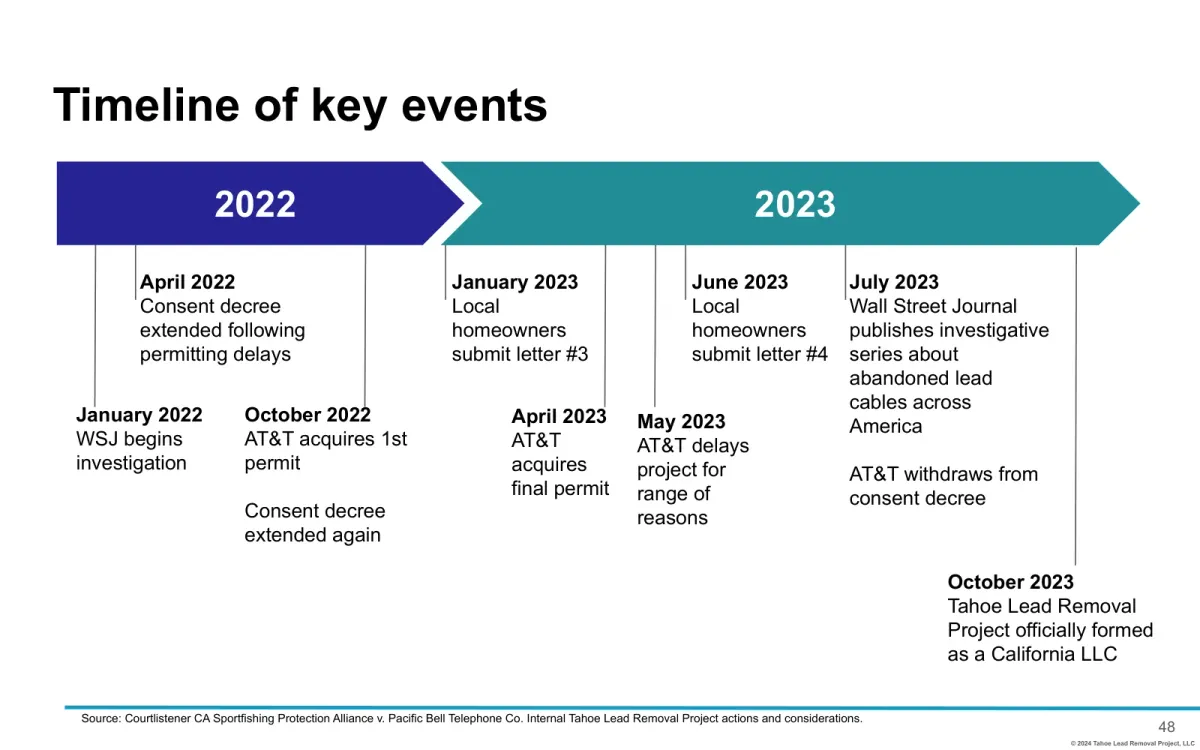
April 2022
January 2023
Consent decree
Local
extended following
homeowners
permitting delays
submit letter #3
January 2022
October 2022
April 2023
WSJ begins
AT&T acquires 1st
AT&T
investigation
permit
acquires final permit
Consent decree extended again
Source: Courtlistener CA Sportfishing Protection Alliance v. Pacific Bell Telephone Co. Internal Tahoe Lead Removal Project actions and considerations.
2023
June 2023
July 2023
Local
Wall Street Journal
homeowners
publishes investigative
submit letter #4
series about abandoned lead cables across
May 2023
America
AT&T delays project for
AT&T withdraws from
range of
consent decree
reasons
October 2023 Tahoe Lead Removal Project officially formed as a California LLC
Timeline of key events
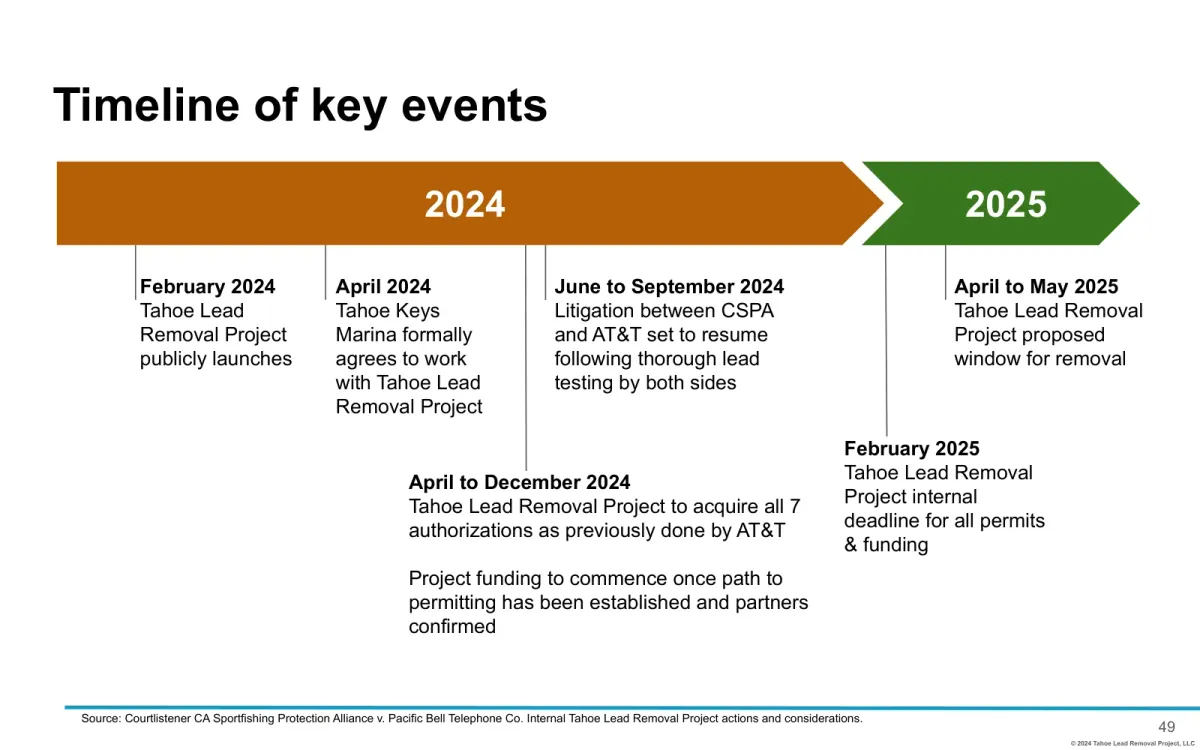
2024
February 2024
April 2024
June to September 2024
Tahoe Lead
Tahoe Keys
Litigation between CSPA
Removal Project
Marina formally
and AT&T set to resume
publicly launches
agrees to work
following thorough lead
with Tahoe Lead
testing by both sides
Removal Project
April to December 2024 Tahoe Lead Removal Project to acquire all 7 authorizations as previously done by AT&T
Project funding to commence once path to permitting has been established and partners confirmed
Source: Courtlistener CA Sportfishing Protection Alliance v. Pacific Bell Telephone Co. Internal Tahoe Lead Removal Project actions and considerations.
2025
April to May 2025 Tahoe Lead Removal Project proposed window for removal
February 2025 Tahoe Lead Removal Project internal deadline for all permits & funding
B. Litigation Considerations
Ligation Consideration: CSPA vs. Pacific Bell
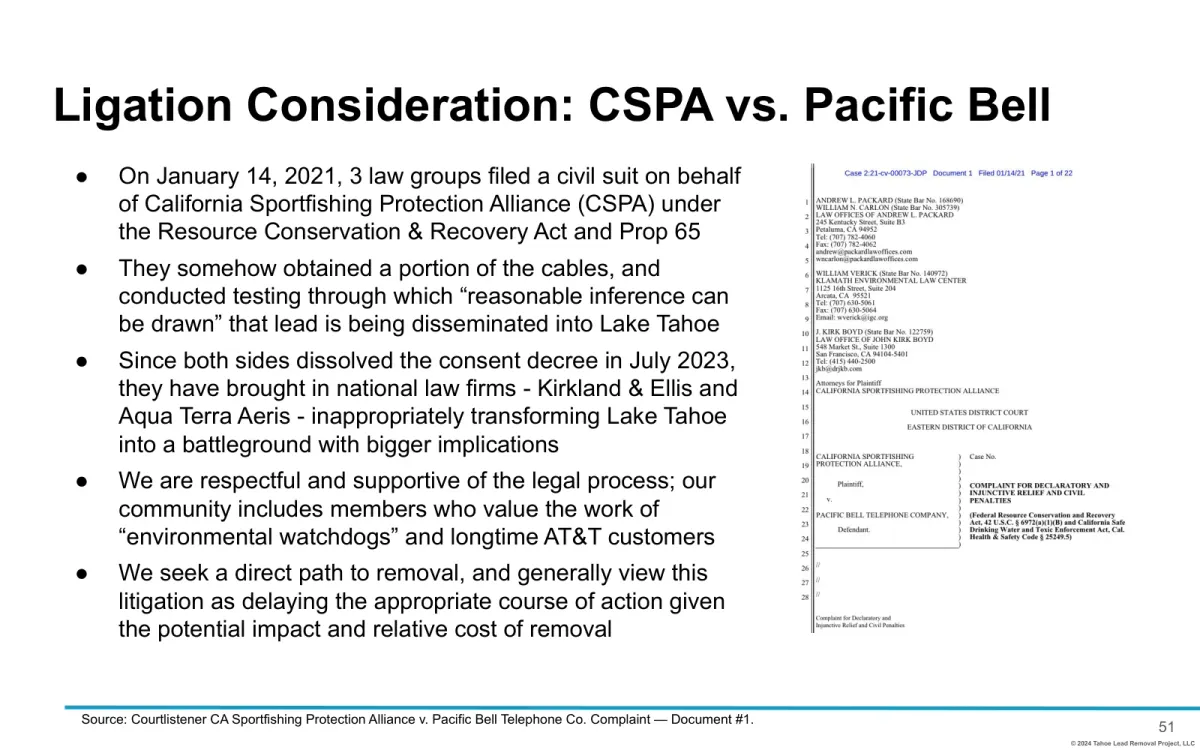
- On January 14, 2021, 3 law groups filed a civil suit on behalf of California Sportfishing Protection Alliance (CSPA) under the Resource Conservation & Recovery Act and Prop 65
- They somehow obtained a portion of the cables, and conducted testing through which “reasonable inference can be drawn” that lead is being disseminated into Lake Tahoe
- Since both sides dissolved the consent decree in July 2023, they have brought in national law firms - Kirkland & Ellis and Aqua Terra Aeris - inappropriately transforming Lake Tahoe into a battleground with bigger implications
- We are respectful and supportive of the legal process; our community includes members who value the work of “environmental watchdogs” and longtime AT&T customers
- We seek a direct path to removal, and generally view this litigation as delaying the appropriate course of action given the potential impact and relative cost of removal
Source: Courtlistener CA Sportfishing Protection Alliance v. Pacific Bell Telephone Co. Complaint — Document #1.
The lawsuit continues to be delayed, impairing action
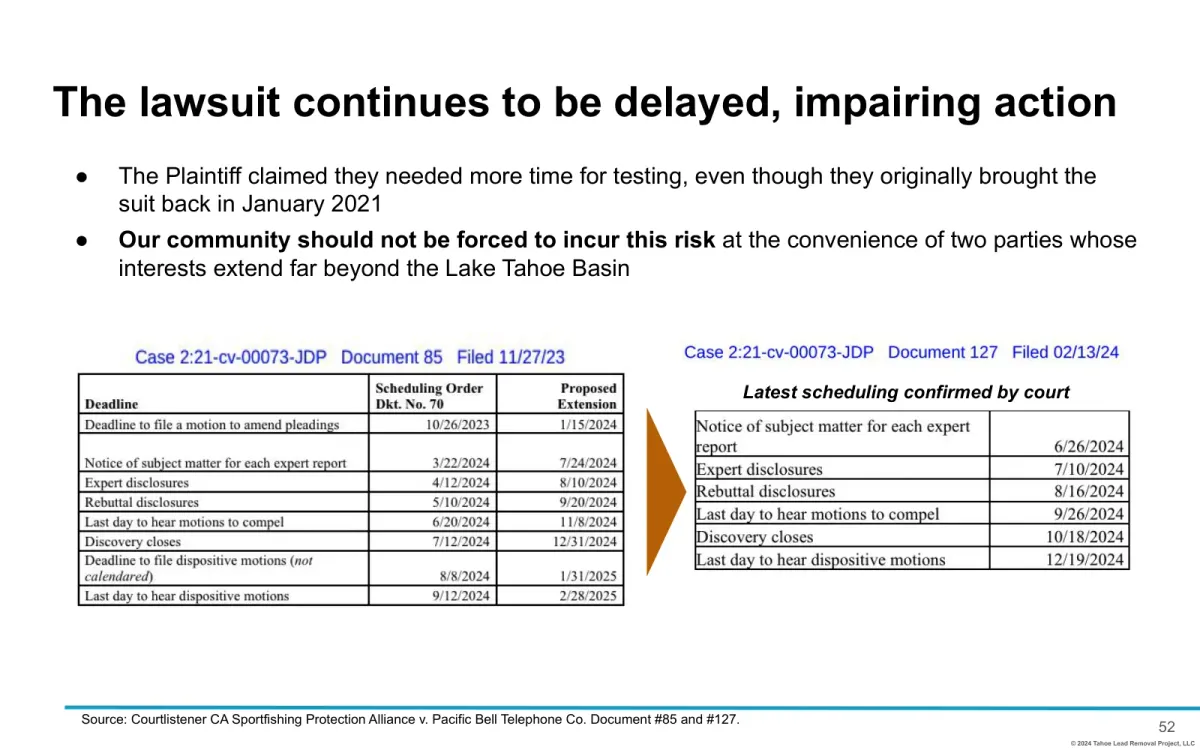
- The Plaintiff claimed they needed more time for testing, even though they originally brought the suit back in January 2021
- Our community should not be forced to incur this risk at the convenience of two parties whose interests extend far beyond the Lake Tahoe Basin
Source: Courtlistener CA Sportfishing Protection Alliance v. Pacific Bell Telephone Co. Document #85 and #127.
Latest scheduling confirmed by court
A prolonged legal dispute exacerbates key risks
- The current litigation brings additional layers of complexity to an inherently challenging situation
- We appreciate that taking decisive action ahead of finality in this case is complicated
- Since the beginning we have aimed for a Spring 2025 removal, specifically given this dynamic - we wanted to ensure the legal proceedings had concluded
- However, it’s increasingly apparent that both sides are willing to extend this process well into 2025 and perhaps beyond
- This development is concerning, as key permits expire in 2025 - potentially extending the timeline for removal even if the sides agree on that course of action again
- Given the Wall Street Journal’s accusations, its apparent that this is case has nationwide implications which is why the focus is on lead testing - but Lake Tahoe is not their scientific laboratory
- Every year this removal project is delayed and deprioritized increases the risk of catastrophe
- That’s another year of erosion, anchors, and potential for an earthquake
AT&T has invested in legal & compliance for years ● For nearly 27 years, AT&T has employed an attorney
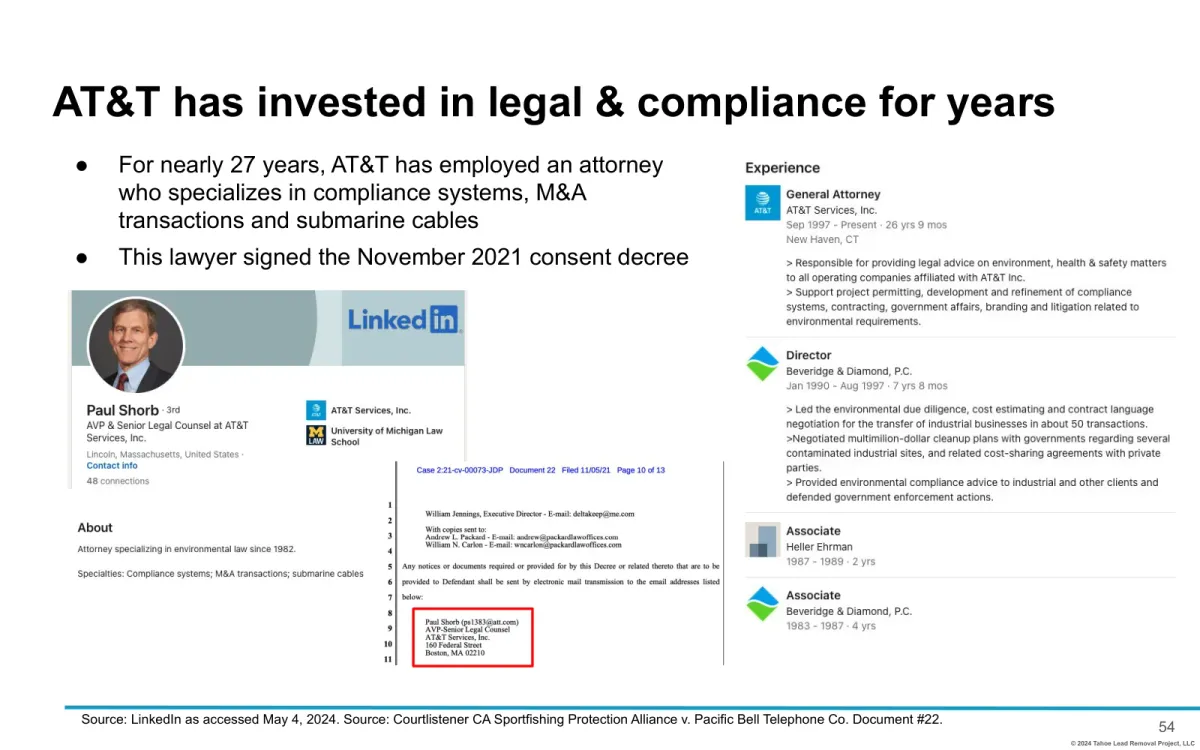
who specializes in compliance systems, M&A transactions and submarine cables
- This lawyer signed the November 2021 consent decree
Source: LinkedIn as accessed May 4, 2024. Source: Courtlistener CA Sportfishing Protection Alliance v. Pacific Bell Telephone Co. Document #22.
C. Nationwide Momentum

EPA continues to press on this issue nationwide
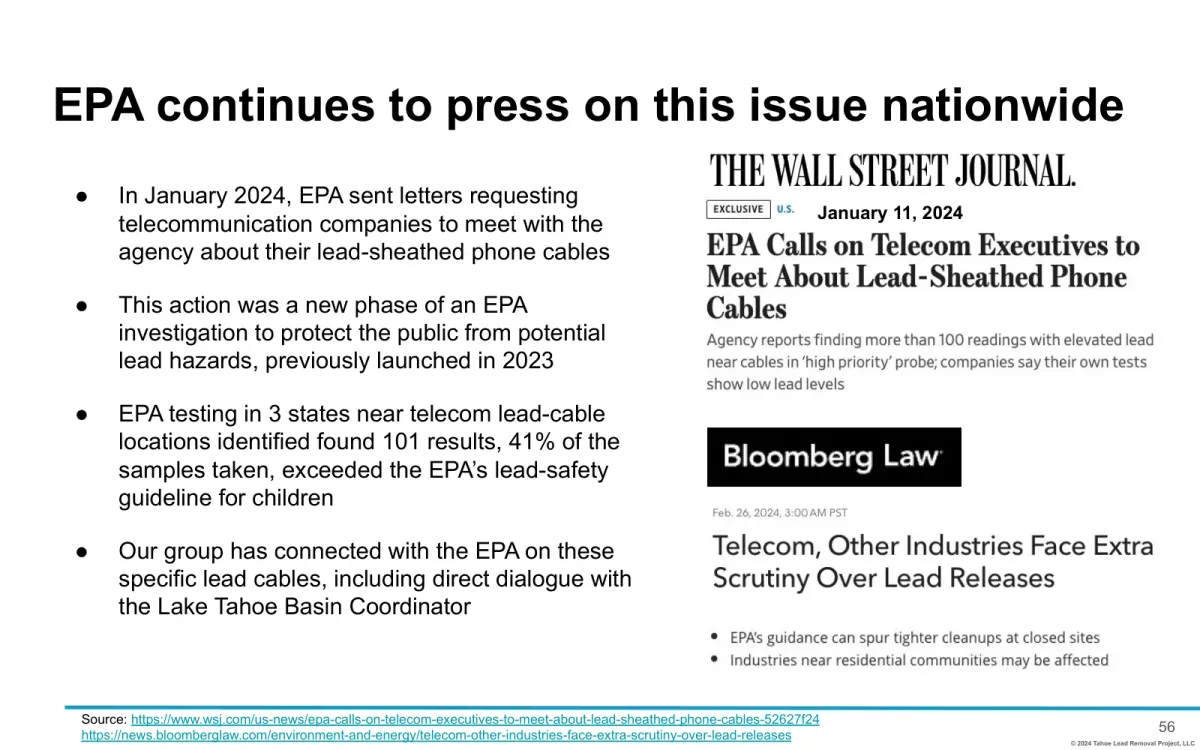
- In January 2024, EPA sent letters requesting telecommunication companies to meet with the agency about their lead-sheathed phone cables
- This action was a new phase of an EPA investigation to protect the public from potential lead hazards, previously launched in 2023
- EPA testing in 3 states near telecom lead-cable locations identified found 101 results, 41% of the samples taken, exceeded the EPA’s lead-safety guideline for children
- Our group has connected with the EPA on these specific lead cables, including direct dialogue with the Lake Tahoe Basin Coordinator
Source: https://www.wsj.com/us-news/epa-calls-on-telecom-executives-to-meet-about-lead-sheathed-phone-cables-52627f24
https://news.bloomberglaw.com/environment-and-energy/telecom-other-industries-face-extra-scrutiny-over-lead-releases
January 11, 2024
Elected representatives have joined in call for action

- There is bipartisan consensus around this issue, as confirmed by members of both the U.S. Senate and House of Representatives
- Representatives on both side of the aisle commenting on these potential risks to our communities highlights the importance of this issue and path forward
“There is no safe level of lead exposure—none—which is why
I’m so disturbed by these reports of lead cable lines
throughout the country”
Representative Frank Pallone, Jr (R., NJ), ranking member
of the House Energy and Commerce committee
“We take seriously the concerns raised about potential lead
exposure from communications lines—including the
infrastructure that first connected so many remote and
rural parts of the country,” FCC spokesperson
Source: https://www.wsj.com/articles/lawmakers-demand-telecom-firms-act-on-toxic-lead-cables-after-wsj-investigation-9c4f6a09
July 11, 2023
“Exposure to lead in our soil and water can significantly
harm public health, especially for children in frontline
communities. As we learn more about the impact of these
abandoned lead cables across our country, we must ensure
that we are taking all the necessary steps and actions to
protect communities from lead exposure.”
U.S. Senator Tom Carper (D., Del.), chairman of the
Environment and Public Works Committee
