Corrosion of Metals—II. Lead and Lead-Alloy Cable Sheathing
Cite this paper
R. M. Burns, "Corrosion of Metals—II. Lead and Lead-Alloy Cable Sheathing," Bell System Technical Journal, vol. 15, no. 4, October 1936, pp. 603–625.
Full text
Corrosion of Metals—II. Lead and Lead-Alloy Cable Sheathing
By R. M. BURNS
This paper discusses the corrosion of cable sheathing in the aerial and underground cable plants. Corrosion does not appear to be a primary factor affecting the life of aerial cables; failure of these cables occurs usually from intergranular embrittlement and is minimized by the use of alloy sheathing. It is shown that corrosion of cable sheathing in conduit occurs by means of the operation of small corrosion cells on the surface of the sheath or by the leakage of current from the sheath to ground. The driving force of these corrosion cells arises from some chemical inhomogeneity in either the metal or the surrounding environment. The course and the character of corrosion is determined chiefly by the influence of the constituents of the environment on the operation of these cells. These constituents may be classed as corroding or protective;—the corroding including oxygen, nitrates, alkalies and organic acids, while the protective are silicates, sulfates, carbonates, soil colloids and certain organic compounds. Cable sheathing buried directly in soils is seriously corroded by differential aeration-cell action resulting from physical contact of relatively large soil particles and metal. In general it is concluded that corrosion of cable sheathing is influenced more by the nature of the environment than by the chemical composition of the metallic material. The incidence of corrosion of cable sheathing is small owing to the maintenance of non-corrosive chemical and electrical environments in the cable plant.
THE intricate cable network of the telephone system offers numerous opportunities for the occurrence of corrosion. The property damage resulting from perforation of the sheathing by corrosion and the attending costly interruption of service have served to make the prevention of cable failure a matter of primary concern. The relatively low incidence of actual corrosion failures can be attributed largely to the vigilance of the electrolysis engineers and the plant forces.
Cable sheathing is one of the largest single uses of metallic lead. In 1929 it exceeded even that employed in the manufacture of storage batteries and constituted about 27 per cent of the entire consumption in this country. In the past fifteen years over two million tons of lead have gone into the communications and power cable plants. In the Bell System alone there are about 180,000 miles of lead alloy covered cables, about forty per cent of which are underground. About 95 per cent of the total mileage of telephone wires is in cable, the proportion of open wire construction decreasing each year.
The earliest telephone cables were of the type employed in telegraph practice, the individual wires being insulated with rubber or gutta p. 604 percha and the core covered with a rubber or textile sheathing. The first lead-covered telephone cables were made by David Brooks, Jr., and were installed in the year 1880. These consisted of cotton-covered wires drawn into a lead pipe—a moisture-proofing compound of rosin and paraffin being forced afterward into the pipe and allowed to solidify by cooling. The Western Electric Company began the manufacture of lead-covered telephone cables in 1881. These were of the so-called "Patterson" type and employed cotton-covered wires drawn into a lead pipe after which melted paraffin charged with carbon dioxide under high pressure, was forced into the pipe and allowed to cool, forming thereby a solid cake of paraffin between the core and the pipe. Cotton-wrapped wire alone took the place of this structure in 1884 and some four years later paper began to be substituted for cotton. Beginning in 1882 telephone cables were sheathed with an alloy of 97 per cent lead and 3 per cent tin, which continued to be the standard composition for cable sheathing in the Bell System until 1912. The general adoption of the present standard alloy of lead with 1 per cent antimony in that year has afforded substantial economies and a sheathing of high resistance to fatigue cracking. Recently, a new development, lead hardened with 0.03–0.04 per cent calcium, has shown in laboratory tests some promise as a cable sheathing material. In England ternary alloys of lead with cadmium and tin or with cadmium and antimony have been proposed. Unalloyed commercial lead is the covering generally used for power cables.
The lead which best lends itself to the manufacture of lead-antimony cable sheathing is a high-copper, low-bismuth chemical grade of lead of the following nominal composition:
| Silver | 0.002 to 0.02% |
| Copper | 0.04 to 0.08% |
| Bismuth | 0.005% (max.) |
| Arsenic, antimony and tin together | 0.002 (max.) |
| Zinc | 0.001 (max.) |
| Iron | 0.0015 (max.) |
| Lead (by diff.) | 99.90 |
There is no evidence that the copper content of this lead has any significant effect upon corrodibility when used in 1 per cent antimony sheathing, although it does appear to be a factor in certain other uses. Indeed, chemical composition appears to be of lesser importance than environmental influences in the corrosion of cable sheathing. The prevention of corrosion failures is mainly a matter of providing and maintaining non-corrosive chemical and electrical environments.
While the choice of lead as a cable sheathing material was dictated primarily by physical requirements, notably its adaptability to extrusion, p. 605 corrosion resistance has been a large factor undoubtedly in its successful use. It has long been recognized that lead is one of the least corrodible of metals. Its dull unreactive character is synonymous with inertness. Widely used in ancient times for water pipes, roofings, caskets, linings for public baths, etc., many specimens have come down to us in nearly perfect states of preservation. The Romans, for example, employed lead water pipes in fifteen standard sizes usually ten feet in length1 and some of these pipes are said to be in use today. In the form of roofings many examples exist which are five centuries old. It seems likely that corrosion has been less destructive than war to the original lead roofs of medieval cathedrals and buildings. Once a protective film has formed on lead the metal may be preserved indefinitely if not physically disturbed. In the air this film is usually an oxide while in the case of underground burial the film which forms on lead may be a silicate or in some cases merely a film of hydrogen shielded by the presence of soil colloids. In other instances sulfates and carbonates exert a retarding influence. Whether or not a protective film forms depends largely upon the character of the environment to which the metal is exposed. Under unfavorable conditions, such as exposure to acetic acid vapors, strong alkalies or contact with large soil particles, lead may be readily corroded. Purity of the metal plays a minor role in corrodibility in the atmosphere although it may affect its behavior in soil waters and other electrolytes.
The widely different conditions of exposure which prevail in the aerial and underground cable plants make it desirable to consider them separately. Corrosion caused by stray electrical currents, since it occurs mainly in the underground plant, will be discussed under that heading.
Corrosion of Aerial Cables
Corrosion is not a primary factor in the life of aerial cables. Failure of these cables is usually due to cracking and confined to sections which are subjected to repeated stresses or in some cases to prolonged mechanical vibration.2 It is now recognized that the nature of the environment affects the endurance of metals to such stressing and vibration, and the term "corrosion-fatigue" has been applied to the embrittlement and cracking which result from the simultaneous application of tensile and compressive stresses and corrosive media.
The resistance of lead to corrosion-fatigue is lowered, for example, by exposure to the atmosphere.3 Evidently the protective oxide coating which forms on lead in the air4 is not only ineffective in preventing intercrystalline fracture under repeated stressing, but actually constitutes an accelerating factor. The specific volume of lead oxide is p. 606 greater than that of the metal from which it is derived5 and it has been suggested that the presence of the oxide provides some sort of leverage which aids embrittlement.6 It is possible that differential aeration cell action may be involved for it is conceivable that the surface oxide film in the region of the grain boundaries is the most susceptible to rupture, producing thereby areas which are anodic to the adjacent unfractured surfaces.
Intercrystalline corrosion of lead may be produced in the laboratory merely by immersion of the specimen in a solution of nitric acid and lead acetate.7 The attack in this case, as also in the case of the simultaneous action of tensile stress and corrosion, occurs along the grain boundaries leaving individual grains of lead which retain the characteristics of the original metal.8 While intergranular corrosion of this type can be produced in lead of high purity, the rate of attack in a given medium is usually a function of the purity of the metal.
Exclusion of the atmosphere or the use of coatings of certain oils or grease have been shown to retard the rate at which lead is embrittled by corrosion-fatigue.9 More practical means of minimizing the intergranular failure of cable sheathing lies in modification of the composition of the sheathing.
Alloying with 3 per cent tin, or 1 per cent antimony materially increases the resistance of lead to intercrystalline embrittlement.10 The antimony alloy has a considerably greater fatigue resistance than pure lead as measured in a certain type of laboratory fatigue test11 but decreases in time, or when the alloy is cold worked, owing to an agglomeration of the dispersed antimony particles which occurs particularly in the region near the grain boundaries.12 Lead alloyed with 0.04 per cent calcium and suitably age-hardened has been shown in laboratory tests to have a much higher resistance to fatigue failure than the 1 per cent antimony alloy.13 Certain ternary alloys of lead containing cadmium are said to possess marked resistance to fatigue failure.14 More recently lead containing 0.1 per cent tellurium has been shown to be about 3-fold more resistant than ordinary lead to mechanical vibration.15 It should be emphasized that all of these comparisons of fatigue resistance were made in laboratory tests and are not based on field experience.
From the foregoing it will be seen that for the most part the aerial cable plant does not present a serious corrosion problem. The importance of the unavoidable environmental influences on sheath embrittlement is minimized by the use of lead alloy sheathing together with proper methods of cable suspension. Other types of lead corrosion are rare in aerial cables.
Corrosion of Lead Directly Buried in Soils
It is not the practice of the Bell System to bury lead-covered cables directly in the soil without the use of a protective coating. Recognition of the corrosion hazard involved in such construction is one of the considerations which led to the use of conduit for the housing of even the first cables which were placed underground. The more recent actual experience of certain small users with soil corrosion has served to confirm the soundness of this practice. The idea that cable sheathing might be buried safely in direct contact with soils was suggested by the fact that lead had been widely used as water pipes.16 Many miles of telephone cables accordingly were laid directly in the earth, notably in Indiana, and frequently with unfortunate results.
In certain sections where it is considered economical to bury cables in the ground, a coating has been devised for the protection of the sheathing against corrosion. This consists in wrapping the lead-alloy sheathed cable with asphalt-impregnated paper followed by one or more layers of jute impregnated with a preservative compound, and in some cases steel tape armoring over which there is wrapped a final layer of jute. The structure is flooded with asphalt before and after each serving of paper and each layer of jute. The steel tape is employed where there exists any danger of induction from power lines; it may be omitted in locations where there is little likelihood of trouble from this source.
Before discussing the corrosion of cables in conduit, which is the principal concern of the present paper, it will be of interest to review the results of corrosion studies which have been made on lead and lead-alloy sheathing materials buried directly in soils. In addition to the presence of soluble salts, the underground environment in this case involves direct contact of the metal with relatively large soil particles and aggregates—a markedly heterogeneous condition. These points of contact of soil particles and metal become areas of reduced oxygen concentration as compared with surrounding regions of the metal surface which are more freely accessible to the soil atmosphere. The resulting oxygen concentration cells with a driving force of approximately 100 millivolts provide one of the most important means by which metals corrode in soils. The use of conduit affords an effective barrier against soil action of this character. Silt deposits which sometimes occur on cables in conduit do not give rise to differential aeration action probably because under such circumstances cathodic polarization of the corrosion cells is maintained.17 This inhibitive function of soil colloids has been observed recently in connection with a study of p. 608 the corrosion-fatigue of drill pipe18 and appears to be an important factor in the retardation of corrosion in certain soils.
The most extensive soil corrosion test is that which has been carried on under the auspices of the National Bureau of Standards.19 In this test, specimens of both ferrous and non-ferrous metals were buried in 48 different soils in various parts of the country. Commercial lead and lead containing 1 per cent antimony were placed in these locations and specimens of these have been removed from time to time. These studies have shown that lead and the lead-antimony alloy are corroded by most soils, but at lower rates than are ferrous metals20—losses in weight averaging but 10 per cent and depth of pitting about 25 per cent of those shown by the iron and steel specimens. After approximately 10 years exposure in 18 soils the lead-antimony alloy was found in the majority of cases to be slightly but definitely more corroded than was commercial lead.
A smaller but more intensive soil corrosion test on lead and certain lead-alloys has been carried on by the Bell Telephone Laboratories in five typical soils in the general vicinities of Lafayette and Monon, Indiana. Three grades of lead21 and alloys of these leads with antimony in amounts from 0.8 per cent to 2.5 per cent and with 3 per cent tin were chosen for this test. The specimens consisted of flat plates one square decimeter in area prepared from metal which had been extruded in the form of tape. Before burial these plates were degreased with carbon tetrachloride and scoured with fine sea sand. Five specimens of each material were buried at each location in a horizontal position at a depth of two feet. After a period of four years the specimens were removed from the soil, and after removal of the corrosion products, the losses of weight and the maximum depth of pitting determined.
The values for loss of weight are represented graphically in Fig. 1, in which all of the metallic materials are compared in each of the soils. The arithmetical averages are shown in all cases by means of broken lines. The maximum depth of pitting results showed a close correspondence to the losses of weight. For example, it was least in the Plainfield fine sand and the Fox silt loam and greatest in the Miami silt loam. The only specimens perforated by pitting were the lead-tin alloy and these only in the last mentioned soil.
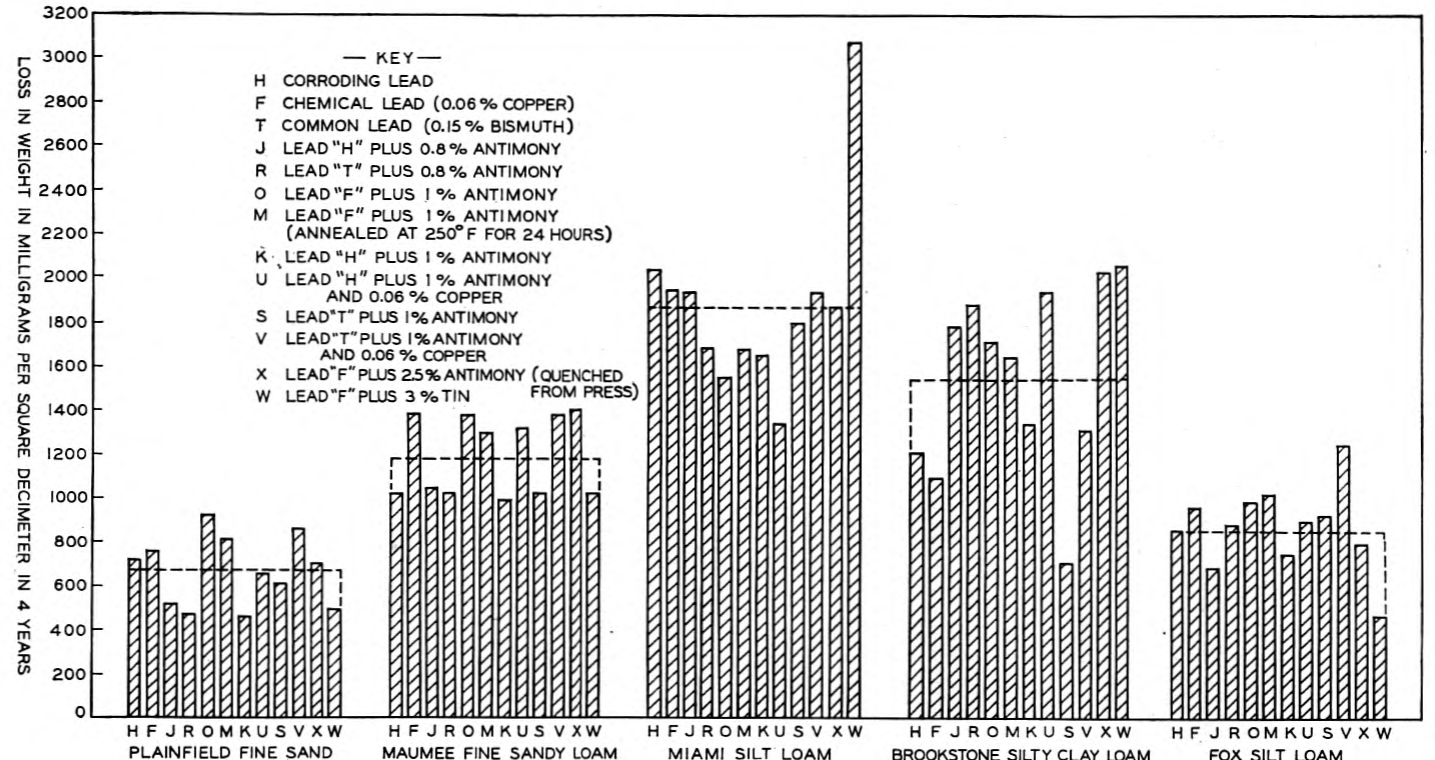
It will be seen that of the two variables, soil character and alloy composition, the former is decidedly the more important in its effect upon rate of corrosion. From an inspection of the data it would appear that there is no definite trend of corrodibility which may be correlated with composition. From a statistical analysis of the data obtained in this test it was concluded that variations in alloy composition within the scope of the test had no significant effect upon the corrosion behavior of the materials. In other words, the variations observed may be ascribed to chance and there is no indication of a significant difference in the rates of corrosion of lead and lead-antimony alloys when buried directly in the earth.
Corrosion of Cables in Conduit
The conduit mainly employed in the underground cable plant of the Bell System is a good grade of vitrified clay with glazed surfaces. Creosoted wood is widely used, particularly for single subsidiary cables. Wood has been employed extensively for main cables on the Pacific Coast where it offered an economical advantage. Steel or iron pipes find a limited application for certain special cases such as dips and relatively sharp bends. Heavy paper or fibre generally embedded in concrete has been used in a few instances. Concrete conduit has been employed by the utilities for power cables and in the telephone field to some extent abroad22 but the danger of corrosion has militated against its adoption by the Bell System. It is possible that the greater heat dissipation of power cables as compared with telephone cables renders concrete conduit less hazardous for power cable use.
The environment to which underground cables in conduit are exposed is complex and varied. It is impossible to exclude moisture and soil air or vapors from the conduit. Surface waters may enter the cable compartments by way of the manholes and soil waters may seep through at duct joints or at small fissures which sometimes develop. The soil atmosphere tends toward higher concentrations of carbon dioxide and lower oxygen than the outside air; it is often high in humidity resulting in the condensation of drops of moisture on the sheathing. Acetic acid vapors arising from wood conduit or other sources may contaminate the duct air. Muddy soil waters may deposit a layer of silt on the sheathing. These waters contain varying amounts of salts, acids or alkalies. Free lime leached from concrete structures or caustic alkali produced, as indicated in the following paragraph, by the electrolysis of sodium chloride are the principal alkaline constituents. Even leakage from sewers is sometimes a contaminating influence which induces corrosion.
In addition to chemical influences, the electrical condition of the cable with respect to earth or to other adjacent metallic structures has an important bearing on corrosion. Where it can be done without jeopardy to other structures, it is desirable to maintain the cable network very slightly (of the order of 0.2 volt) negative or cathodic to earth. There is evidence that under this condition the sheathing is less readily corroded by couple action of a miscellaneous character. At appreciably higher negative potentials alkali or lime salts may be electrolyzed producing thereby caustic alkali or free lime which are corrosive to sheathing. On the other hand, an electrically positive condition of the cable may be conducive to the ordinary "stray-current" or anodic corrosion.
The Origin and Nature of Corrosion Cells on Cable Sheathing
The mechanism by which cable sheathing corrodes in conduit involves the replacement by the metal of hydrogen or another metal in compounds present in the surrounding environment—a process which has been described in some detail in a previous paper.23 Most commonly, the dissolving lead replaces hydrogen from water. The areas or points on the sheathing at which lead dissolves are the anodes of small corrosion cells, the cathodes of which are the regions at which hydrogen is deposited. The driving force of these cells arises either from some chemical or physical inhomogeneity of the metal, or some inhomogeneity of the environment. Their electrolytic operation is influenced by the conductance and chemical nature of the environment, and by the size and distribution of the anodic and cathodic areas.
Corrosion cells owing their origin to sheath composition are exemplified by the presence of two metallic phases, one of which is lead and the other either an impurity, such as copper, bismuth, nickel, zinc, etc., or a hardening agent such as tin, calcium, cadmium, or antimony. Copper and antimony, for example, are cathodic to lead under the prevailing conditions and facilitate the discharge of hydrogen. The small proportion of cathodic area on the metal surface in both cases, however, will result in high cathodic current densities inducing polarization, and a low rate of corrosion except perhaps in acid solutions where the potential of the lead-hydrogen cell will be increased. This acceleration in acid solution is borne out by laboratory corrosion tests which show that the rate of corrosion of lead containing 3 per cent tin is about 50 per cent greater and lead containing 1 per cent antimony is about 10 per cent greater than that of soft lead in dilute (0.001 molar) acetic acid. Antimonial lead is said to corrode more rapidly than pure lead in humic acids.24
Relatively larger areas of copper deposited upon the cable by replacement from copper salts have been observed to promote corrosion of the sheathing. Scraps of copper wire corroded in manholes by saline waters are believed to have been the source of the copper compounds in such cases.
Wiping solder in contact with sheathing at the splicing sleeve provides still another example of a corrosion cell originating from the contact of diverse metals. Laboratory measurements of the potential of this couple in dilute chloride, alkali and acid solutions show solder is usually the anodic or corroding electrode. The observed potential differences in hundredth molar solutions at room temperature were as follows:
| Solution | Potential Difference in Millivolts |
|---|---|
| Potassium chloride | 6 ± 3 |
| Caustic soda | 11 ± 3 |
| Acetic acid | 20 ± 8 |
Similarly, the 3 per cent tin-lead sheathing in contact with 1 per cent antimony sheath would give rise to a galvanic couple in which the former would be anodic but by smaller values of potential than given above for the solder-sheath couple. Ordinarily in the soil water environments which prevail in the underground plant the potentials of neither of these couples is sufficient to maintain current flow and there is no evidence of attack. The few cases of corrosion of this type which have been observed, and which have been characterized by pitting of the solder and even of the sleeving (where this was 3 per cent tin) are believed to have arisen in electrolytes somewhat alkaline in nature which contained abnormally low concentrations of film-forming constituents such as silicates, sulfates or organic colloids.
In general, the influence of metallic composition upon corrodibility may be readily detected by measuring the rate of sulfation of the metallic material in sulfuric acid.25 This test provides a method of measuring surface activity and affords a means of comparing the relative rates at which similar alloys tend to corrode in corrosive environments or tend to become passive in the presence of film-forming constituents. The sulfation-times measured by means of a recording potentiometer have been determined on specimens of leads of various compositions and for several cable sheath alloys in 7-normal sulfuric acid. The averages of four determinations made on each material bore the following relationship to each other, assuming the sulfation time of spectroscopically pure lead to be one hundred:
| Spectroscopically pure lead (99.999% lead) | 100 |
| Corroding lead (A.S.T.M.—Grade I, 99.94% lead) | 80 |
| Chemical lead (A.S.T.M.—Grade II, 99.90% lead, contains 0.06% copper) | 65 |
| Common lead (A.S.T.M.—Grade III, 99.85% lead, contains 0.13% bismuth) | 70 |
| Corroding lead alloyed with 1.5% tin, and 0.25% cadmium | 85 |
| Chemical lead alloyed with 1.5% tin and 0.25% cadmium | 75 |
| Corroding lead alloyed with 3% tin | 70 |
| Chemical lead alloyed with 0.04% calcium | 80 |
| Corroding lead alloyed with 0.04% calcium | 75 |
| Common lead alloyed with 0.04% calcium | 55 |
| Corroding lead alloyed with 0.5% antimony and 0.25% cadmium | 25 |
| Chemical lead alloyed with 0.5% antimony and 0.25% cadmium | 25 |
| Chemical lead alloyed with 1.0% antimony | 20 |
From an inspection of these results it appears that the surface reactivity of lead is markedly increased by the presence of impurities or by alloying with small amounts of other metals. Of the hardening agents chosen for study, tin, tin and cadmium, and calcium exert the smallest influence on rate of sulfation, while antimony, whether used alone or with cadmium, has the most pronounced effect. The presence of small amounts of copper appears to have an accelerating effect upon reactivity as does also the presence of bismuth. This adverse effect of bismuth has been noted in connection with the use of lead in sulfuric acid plants.26 Since the environment in which cables are used contains both corrosive and film-forming substances this comparison of rates of sulfation of lead and its alloys is not necessarily a direct indication of the relative rates of corrosion of these materials when used as cable sheathing.
It is well known that the intensity with which metals tend to ionize is affected by their physical state, small crystals and strained structures possessing higher intensities and therefore more electronegative or anodic potentials than large crystals and annealed structures. In the case, however, of lead and most lead-alloys suitable for cable sheathing, self-annealing occurs at ordinary atmospheric temperatures, and for this reason it is highly improbable that corrosion is ever initiated as a result of physical condition of the metal.27 In the laboratory it was found that lead intensively worked at liquid air temperatures, where self-annealing does not occur, was from 2 to 3 millivolts electronegative to annealed lead when measured immediately afterward at 25° C. in 0.2 normal lead-acetate solution. This potential difference was reproducible but could not be maintained for more than ninety minutes at room temperature.
It is conceivable that scratching or mechanical injury of cable sheathing, such as might occur during installations, could give rise to the familiar metal-metal oxide corrosion cell. The operation of this cell has been demonstrated in a laboratory experiment in which pieces p. 614 of lead covered with litharge were freshly scratched after being submerged in water.28 It is of significance that although corrosion readily occurred in this experiment, there was no attack if the scratch were exposed to the atmosphere for two hours before submersion of the specimen. In other words, the oxide film on lead is readily self-healing and injury to it is unlikely to cause corrosion.
Turning to a consideration of corrosion cells originating from the exposure of the sheathing to an inhomogeneous environment, reference has already been made in discussing soil corrosion to the nature and the importance of oxygen concentration cells, and to the protection which the conduit affords against this hazard. Cables in conduit are seldom subject to contact with the character of inert objects which lead to the establishment of oxygen concentration cells. Relatively large hard particles are generally the most effective agents in producing differential aeration. In the laboratory, lead can be pitted by contact with a glass rod when submerged in a dilute sodium chloride solution. There are a few instances in which cables in conduit appear to have corroded by means of oxygen concentration cells. For example, there is evidence that deep pits in sheathing produced by the leakage of stray currents to earth have continued to deepen to the point of perforation of the sheathing, after removal of positive potential conditions. The bottoms of such pits are less accessible to oxygen and appear in some cases to function as the anodic elements in differential aeration cells. Cases of this kind are generally diagnosed by the field forces as "old action."
Another, but rather uncommon, example of oxygen concentration cell has been observed in the use of a porous duct plugging material contaminated with acetic acid. In this case it seems likely that the naturally protective oxide film on the sheathing was destroyed by the acid following which this region, owing to the exclusion or partial exclusion of oxygen, became anodic to the adjacent areas which were freely accessible to air. Contamination with acetic acid does not appear to be essential to this action since other cases have been reported in which the duct plugging material was free from acid.
Finally there exists the possibility of large scale differential aeration cells where one cable of a multiple run is placed, owing to space limitations, in a dip under a large sewer, but bonded to the other cables. Such a cable may suffer severe corrosion in the region of the dip as a result of the lower oxygen content of the atmosphere in this duct as compared to that prevailing in the other ducts.
The discussion of differential environments has related so far only to oxygen concentration. In a similar manner, underground cables p. 615 may be exposed to different hydrogen ion, metal ion or salt concentrations and where the demarcation between concentration zones is sufficiently pronounced may give rise to differential concentration cells, the driving forces of which have theoretical values of 29.5 millivolts per ten-fold difference in ion concentration. An examination of the Rhineland cable which connects Berlin and Cologne has shown that the most extensive corrosion occurred at points where there was an abrupt change in the character of the soil or geological structure.29 There is usually sufficient diffusion and circulation of underground waters to equalize ionic concentrations and prevent the development of cells of this type assuming serious proportions.
Effect of Environment on Operation of Corrosion Cells
The nature of the more common electrolytic cells by means of which cable sheathing corrodes has been discussed at some length. Consideration will now be given to the manner in which various environmental factors influence the operation of these cells. In general, these factors may be classified either as corroding or film-forming agents, although their influence will depend quite as much upon their concentration as upon their specific nature. It is meaningless to report that a metal corrodes or does not corrode in this or that electrolyte unless full experimental details are given. Only with a complete knowledge of the condition of a metal surface and of the nature and concentrations of the components of its environment can the resulting behavior be predicted. For example, it has been shown that it is often the ratio of the concentrations of film-forming to corroding substances which determines the character of attack.30 For high values of this ratio, the metal will be protected; for low values it will be uniformly corroded, but for intermediate values of this ratio, the surface will be only partly protected with the result that corrosion will be localized in the form of destructive pitting. With these limitations in mind, some of the principal constituents of the environment which affect the behavior of cable sheathing may be classified as follows:
| Corroding | Protective |
|---|---|
| Oxygen | Silicates |
| Nitrates | Sulfates |
| Chlorides | Carbonates |
| Alkalies | Colloidal substances |
| Organic acids | Certain organic compounds |
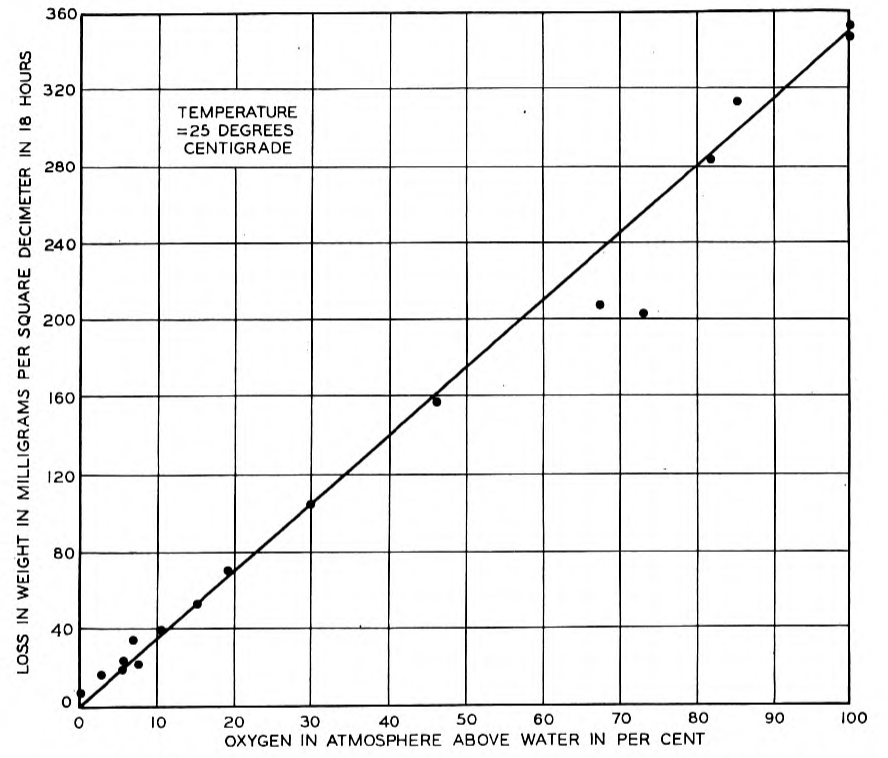
Of the corroding elements, oxygen is the most important in its effect upon the operation of corrosion cells. Owing to the high potential required to discharge hydrogen on pure lead (i.e., its high hydrogen over-voltage) these cells tend to cease functioning owing to p. 616 cathode polarization. The role of metallic impurities of lower overvoltage in discharging hydrogen has already been considered. Oxygen, it is obvious, aids corrosion by depolarizing cathodic areas on the surface of the sheath. That the effect of oxygen is proportional to its partial pressure in the atmosphere has been found in a laboratory study, the results of which are given in Fig. 2. In this experiment six specimens of extruded chemical lead, each of an area of one square decimeter, were prepared for test by degreasing with carbon tetrachloride, and the tarnish film removed by dipping in dilute acetic acid (one part of acid to five parts of water). These specimens washed and dried, and weighed to the nearest milligram, were submerged in large jars of distilled water which had been previously saturated with purified nitrogen, oxygen or various mixtures of the two. The corresponding atmospheres were maintained above the surface to the water during the test. After a period of 18 hours the specimens were removed, washed and the losses of weight determined.
A number of cases of cable sheath corrosion have been attributed to the presence of nitrates in the duct electrolyte. The nitrate content of most soil waters is very low—a few parts per million ordinarily—but occasionally contamination from industrial plants or from sewers, the organic matter from which may undergo nitrification, has led to a several fold increase. Concentrations of nitrate from 20 to 425 parts per million have been found in the electrolyte from locations where failure of the sheathing occurred. It has been shown that solutions containing a thousand parts of nitrates per million are markedly corrosive to lead.31 Another investigator reports that the addition to natural soft waters of nitrates in excess of 50 parts per million increases their corrosiveness about 20 per cent, higher quantities of nitrate being required to produce this effect in hard waters.32 Often the corroded region of the sheath is black in appearance owing to the presence of loosely adherent, finely divided lead (possibly oxidized) and antimony which accumulates by some sort of undermining action during the rapid attack. The formation of this black coating in the presence of nitrates is reported by others.33
The mechanism of nitrate action at the cathodes of corrosion cells is similar to that of oxygen and of lower concentrations of oxidants in general, and consists in depolarization. In addition, the high solubility of lead nitrate prevents an appreciable polarization of anodic areas. It is of interest to note that in the presence of nitrates, in the form of nitric acid, oxygen furnishes but little additional acceleration of corrosion. For example, in 30 per cent nitric acid, the ratio of the rate of corrosion in the presence of oxygen to the rate in the absence of oxygen has been shown to be 1.1, while in 20 per cent hydrochloric acid and glacial acetic acid, this ratio is 10.0 and 10.9, respectively.34
Cable sheathing is little affected by the chloride content of most ground waters. In tests, for example, in which chlorides were added to natural waters, there was no increase in corrosion when the chloride content was of less than 1000 parts per million, a value seldom attained in soil waters.35 Even infiltration of sea water does not constitute a corrosion hazard unless the cable is markedly negative to earth. Indeed, in sea water the corrosion of lead may be retarded by an encrustation of lead chloride which forms on the surface of the metal, as well as by the lower prevailing oxygen content. Extruded bars of lead and lead containing 1.6 per cent antimony, 60 cm. in length and 2.87 cm. in diameter exposed for four years to tidal action have shown losses in weight of 0.65 per cent and 0.51 per cent, respectively,36 but doubtless mechanical erosion was an important factor in this rather drastic test. Laboratory tests made on lead foil in a sodium chloride solution show p. 618 that the rate of corrosion increases with increasing salt concentration up to a maximum at 1 per cent and that at concentrations of 3 per cent, which corresponds roughly to that of sea water, the rate is markedly less.37 The favorable experience with cables submerged in sea water or mixtures of sea water and soil waters indicates that corrosion inhibitive agents exert under these exposures a predominating influence. The effect of the chloride content of the duct electrolyte must be mainly one of increasing the conductivity, there being insufficient concentrations in relation to the concentration of film-forming substances to produce even pitting or local attack.
A type of cable sheath corrosion of considerable importance is that which is fostered by alkalies. It is characterized usually by the formation in the region of attack of deep red crystals of lead monoxide or litharge. Occasionally the yellow form of litharge or a greenish hydrated lead monoxide may appear, but in one case where the strength of caustic was so great as to cause discomfort upon handling the cable, no colored compounds developed. The red monoxide crystallizes out of saturated solutions of alkali plumbites which are formed by the solution of lead in alkalies.38 It can be produced in the laboratory by immersing specimens of lead in saturated lime water and aerating the solution for several days with carbon dioxide-free air. The appearance of this red oxide on cable sheathing is a certain indicator of alkali attack. If detected before failure of the cable, the action can be stopped usually by removing the source of the alkali and thoroughly flushing the cable conduit with water.
A source of alkali affecting underground cables is concrete conduit and occasionally other concrete structures. Free lime in the surface layers of fresh concrete is usually converted by the action of carbon dioxide into calcium carbonate within a few weeks and this is less alkaline in nature. Seepage of moisture through concrete which may occur in less dense grades of this product may leach free lime from within. At the Panama Canal water seeping through the concrete floors and walls of lock chambers caused serious corrosion of the sheathing of power cables in a short time. Analysis of the seepage water disclosed high alkalinity. In the same locality a telephone cable in vitrified clay conduit was corroded by the seepage of water through cement sacks used for wrapping the conduit joints.39 Greater attention is being given recently to the production of concrete conduit of greater impermeability, lower alkalinity and to "curing" methods. The use of high alumina cement, which is much less corrosive to cable sheathing,40 has been proposed.
Another important source of alkali is the electrolysis of sodium chloride or common salt by electrical currents flowing to the cables. Under these conditions caustic soda is produced at the sheath which is cathodic or negative to earth; hence the terms “cathodic” or “negative” corrosion. The salt usually comes from that used in the winter to thaw out street car switches, although in one case it has been traced to the drippage from salt-ice mixtures of ice-cream delivery trucks. In still another case, a power cable, negative to earth, suffered alkaline attack as the result of the electrolysis of alkali salts concentrated at a low point in the cable run by heat dissipation of the cable. Finally it should be mentioned that the use of calcium chloride on streets for melting snow or laying dust would lead undoubtedly to its coming in contact with the underground cable plant and being converted into corrosive free lime in areas negative to earth.
It has been known since the Middle Ages that lead is corroded by acetic acid. In the presence of the carbon dioxide of the atmosphere, the corrosion product is the pigment, white lead. The attack manifests itself by the formation of a white encasement around the globules of moisture on the sheath; at first a mottled effect is produced which in time develops into a heavy white encrustation of the carbonate or basic carbonate of lead. The early use of wood conduit was attended with occasional cases of acetic acid corrosion and it was found that the wood tar creosote used as the preservative contained this acid. Since that time coal tar creosotes have been specified for the preservation of wood conduit. The conduit most widely used in this country is yellow pine. Properly creosoted this product has not been known in Bell System experience to cause corrosion except when used under such unusual circumstances as close proximity with steam pipes or exposed on viaducts over railroad yards to the heat of locomotive stacks. In these cases acetic acid was liberated as a product of the slow decomposition of the wood. A recent instance of acetic acid attack in creosoted conduit manufactured from southern yellow pine has been reported and attributed to acid liberated by the destructive decomposition of the wood by the Kansas sun.41
The most serious corrosion of cables by acetic acid on record is that which occurred on the Pacific Coast in creosoted Douglas fir conduit a few years ago.42 Following the initial satisfactory use of this product for subsidiary cables it was employed extensively for main communication subways. With the expansion of the cable plant into this newly constructed duct system several cases of acetic acid corrosion occurred—most of them within the first 15 months in conduit of recent installation. Analysis of the atmosphere within the cable compartments p. 620 revealed the presence of corrosive concentrations of acetic acid. In the investigation made of this trouble it was concluded that the high native acidity of Douglas fir, together with the drastic treatment required to impregnate it with creosote, offered a reasonable explanation for the corrosiveness of the conduit.43 The corrosive action was effectively stopped by neutralizing the acid with ammonia gas supplied to the affected conduit in a 2 per cent mixture with air.
The corrosiveness of air laden with acetic acid vapors lies in the persistence of effective non-polarized corrosion cells of constant voltage. The acid furnishes an abundant and reasonably constant source of replaceable hydrogen ions and the continued precipitation of lead as carbonate by the action of carbon dioxide maintains a low concentration of lead ions. Oxygen acts as a cathodic depolarizer. Since the precipitation of lead carbonate or basic carbonate occurs at an appreciable, although very small, distance from the seat of activity on the metal surface, it offers little or no hindrance to the corrosion action.
Phenols and other acidic constituents of coal tar pitches have been reported to be corrosive to cable sheathing when in direct contact in the form of protective coatings.44 There is no evidence either from experience with creosoted conduit or from laboratory tests that phenolic vapors from creosote are appreciably corrosive to sheath.
So much for the corrosive media of the environment of the underground cable plant. Of the protective agents, none is more important than soluble silicates. It is well known that lead is markedly corroded in distilled water, and by waters low in hardness and in total solids. Saturation of distilled water with calcium silicate (soluble to the extent of about 100 parts per million), or with silicic acid derived from a suspension of silica flour, will prevent corrosion of lead. The corrosiveness of certain natural waters has been greatly reduced by the addition of only 10 parts of sodium silicate (expressed as silicic acid) per million.45 Analysis of a large number of samples of waters from cable manholes and subways has shown silicate contents of from 2 to 25 parts per million. In concrete conduit values up to 143 parts per million have been found. It is of interest in this connection to note that although silicates appear to protect lead to some extent in all ground waters, their effectiveness is greatest in the range of alkalinity corresponding to values of pH between 9 and 11, where pH equals the logarithm of the reciprocal of hydrogen-ion concentration. The resistance of underground cables to corrosion appears to depend chiefly upon the film-forming action of silicates. The minimum concentrations required to give protection depend upon the nature and concentrations of the corroding agents which are also present.
The effectiveness of silicates in passivating lead lies in the extremely low solubility of lead silicate. Consequently silicate ions are precipitated as lead silicate in close contact with the sheath at the anodic areas of the corrosion cells. As the more anodic regions become polarized in this fashion other areas tend to function as anodes but with the same result until the surface of the sheath becomes entirely covered with an insoluble coating of lead silicate which is impervious to the corrosive elements of the environment.
Chromates and phosphates stand next to silicates in ability to passivate lead, but do not occur in the electrolytes in contact with underground cables. Sulfates, however, are a common constituent of these environments and in laboratory studies have been shown to be as effective as phosphates.46 The passivating effect of sulfates is directly proportional to concentration, 2500 parts per million reducing the rate of corrosion of distilled water about 50 per cent.47 Electrolytes from the cable plant seldom contain as much as 10 per cent of this amount of sulfate and so the specific contribution of sulfates alone is not large; however, added to that of various other film-formers it is of importance.
Carbonates exert a marked retarding influence on the corrosion of lead. The water which comes in contact with underground cables always contains carbonate ions derived either from soluble carbonates from the soil or from carbon dioxide of the soil atmosphere. Numerous analyses of the air in cable ducts has shown it to run from 0.1 per cent to 10 per cent of carbon dioxide, usually averaging about 1.5 per cent or 0.015 atmospheres pressure. Pressures of carbon dioxide within this range reduce the rate of corrosion of lead in distilled water about 50 per cent. It is claimed that high pressures of carbon dioxide, e.g., 6 atmospheres, increases the solvent action of water on lead.48 Carbonate equilibria calculations of the system lead carbonate-carbon dioxide-water show that the film of corrosion products which forms on lead in aerated distilled water is a hydrated oxide of lead when the partial pressure of carbon dioxide is less than atmospheres. Above this value for carbon dioxide and up to a pressure of about 10 atmospheres, the film should consist of lead carbonate. Basic carbonate, if a true solid phase, should also be found within this range. The bicarbonate of lead would appear to be stable at still higher carbon dioxide pressures. It is of interest that there is a minimum in the calculated solubility curve for lead carbonate in the region of atmospheres of carbon dioxide. Increasing solubility at pressures greater than this is due to the increasing concentration of bicarbonate ions. This means that the effectiveness of soil carbonates in passivating cable sheathing is somewhat reduced by the higher carbon dioxide p. 622 pressures which obtain underground. It is still, however, one of the most important of corrosion inhibitors.
Mention has already been made of the protective influence under certain circumstances of silt or clay deposits on the surface of the sheath. There are in the underground electrolyte many other substances mainly organic in nature and often colloidal which aid in the preservation of cable sheathing. Whereas the anions, such as silicates, sulfates, and carbonates, induce passivity by a process of anodic polarization of corrosion cells, the inhibitive mechanism of soil colloids and of the organic materials in soil electrolytes is usually one involving cathodic polarization of these cells.
Stray Current Corrosion
The most common kind of cable sheath corrosion, the most destructive and best recognized, is that which occurs when electrical currents flow from the sheath to ground. In this case the portion of cable of higher potential than earth has the general characteristics of an anode, while the cathode is some extraneous structure. The potentials between anode and cathode may be and generally are greater than those which are possible for the electrolytic corrosion cells which have been described at length in this paper. The size of the currents which may flow for a given potential will of course depend upon the resistance of the path, i.e., upon the electrolytic resistance of the soil solution in contact with the cable. The size of the anodic area will depend upon the area of the sheath in contact with the electrolyte. The nature of the corrosive attack accordingly will depend upon this area and the rate of current flow or, in other words, the current density. In appearance the corroded area may be a clean cut pit or pits, or it may be roughly etched. When the potential is greater than about 2 volts, a brown colored anodic oxidation product, lead peroxide, may be formed. A simple test for this—the blue coloration which develops when a small amount of it is dissolved in a 5 per cent solution of tetramethyldiaminodiphenylmethane containing dilute acetic acid—is a certain indicator of anodic action. A negative result with this test, which is the more common experience, does not, however, exclude the possibility that the attack was anodic in character; the potential to earth may have been too small or the peroxide may have been actually formed but may have been consumed by local action following removal of the positive sheath potential.
Occasionally lead chloride, a white salt, may be formed in the corroded areas under anodic conditions. Thus, the finding of a relatively greater concentration of chloride in the corrosion product p. 623 than in the surrounding environment is trustworthy evidence of anodic corrosion.
The corrosion efficiency of stray current anodic corrosion, i.e., the per cent of the current involved in dissolving lead, will often be appreciably less than 100 per cent. The complementary anodic reaction occurring at voltages greater than approximately 2 volts is the evolution of oxygen. For example, in an extract of a black alkali soil containing high concentrations of sulfates, tests showed that less than 1 per cent of the current was consumed in the dissolution of lead. Under the conditions generally prevailing, however, it is likely that the corrosion efficiency is reasonably high and that the amount of corrosion will be nearly proportional to the amount of current which flows from the sheath to ground.
Cathodic or negative corrosion of cable sheathing, which occurs when current flows from earth to the sheath, has been described already under the discussion of alkaline corrosion. A not uncommon indication of negative conditions is an encrustation of calcium carbonate on the cable. In this case the sheathing is generally not corroded. It seems likely that the alkali produced by electrolysis of lime salts is carbonated as formed and before reaching sufficiently high concentration to initiate corrosion and that calcium carbonate so formed crystallizes on the surface of the sheathing.
Instances have been observed in which cable sheathing appeared to have corroded from the inside surface.49 It is believed that the action in these cases was preceded by the occurrence of cracks or fissures in the sheath which admitted moisture and provided electrolytic paths by means of which current flowed from the sheathing to the copper conductors within.
Destruction of cable sheathing by stray electrical currents derived from large-scale galvanic cells has been experienced. In this case, which at first was rather mysterious, it was found that contact of iron pipes with beds of buried cinders set up large iron-carbon couples with potentials of approximately 0.7 volt. The soil at this location was unusually low in resistance and the wood conduit in which the cables were housed was water-logged with the result that the cables picked up current in regions near the iron structures and lost it at other points where the cable passed through the general neighborhood of the cinder beds. The electrical condition of the cables, determined by pulling through an adjacent duct a modified calomel reference electrode,50 showed that the potential of the cable with respect to earth varied sharply from point to point and often reversed itself more than once in a section between two manholes. Removal of corroded cables p. 624 always confirmed the duct survey as to the location of anodic regions. The trouble was corrected by removal of the cinder beds.
Summary
In summarization it may be stated that corrosion is not a primary factor affecting the life of aerial cables. The tendency of lead to crack as a result of repeated stressing has been minimized by alloying with one per cent of antimony, and aerial cables sheathed with this alloy have shown satisfactory resistance to embrittlement of this character. When cable sheathing materials are buried in direct contact with soils, serious corrosion develops as a result of differential aeration cell action, and appears to have little or no relation to chemical composition of the metallic material. In addition to corrosion cells which originate in some inhomogeneity of the environment, such as the partial exclusion of air, corrosion of cable sheathing may occur by means of galvanic cells arising from the presence of metallic impurities or contact with a more noble metal such as copper. The electrolytic operation of these corrosion cells is influenced by the conductance of the surrounding electrolyte and the chemical nature of its components. Such constituents as oxygen, nitrates, alkalies, organic acids and chlorides (in low concentrations) facilitate the operation of these cells, thereby increasing the rate of corrosion, whereas silicates, sulfates, carbonates, colloids and certain organic compounds of the soil waters exert a protective action which may retard or prevent corrosion. Finally mention is made of the characteristics of the most common kind of corrosion, that due to stray electrical currents. This may occur as anodic action when current flows from the cable to earth, or it may occur as cathodic action when the current flows in the reverse direction if there be sufficient concentrations of alkali or lime salts in the surrounding electrolyte.
From the description of the occurrence and general characteristics of cable sheath corrosion in the present paper it may be concluded that although there are many conditions under which cables may corrode, the actual incidence of corrosion is small owing to the maintenance of non-corrosive chemical and electrical environments in the cable plant.
References
Notes
-
"Useful Information about Lead," Lead Ind. Assn. 1931, New York. ↩
-
Archbutt, Met. Ind. (London), 18, 341 (1921). ↩
-
Gough and Sopwith, Jour. Inst. Met., 56, 55 (1935). ↩
-
Burns, Bell Sys. Tech. Jour., 15, 20 (1936). For fuller details see Vernon, Trans. Faraday Soc., 19, 839 (1924); 23, 113 (1927) from whose work the curves of Fig. 1 of this reference were adapted. ↩
-
Pilling and Bedworth, Jour. Inst. Met., 29, 529 (1923). ↩
-
Vernon, Discussion, Jour. Inst. Met., 56, 84 (1935). ↩
-
p. 625 Rawdon, Bureau of Standards Scientific Paper 377 (1920). ↩
-
Rawdon, Indus. and Engg. Chem., 19, 613 (1927). ↩
-
Haigh and Jones, Jour. Inst. Met., 43, 271 (1930). ↩
-
Haehnel, Elekt. Nachrichten, 2, 74, 330 (1925); 3, 97, 229 (1926); Z. f. Metallk., 19, 492 (1927). Lussaud and Noirclerc, Rev. Gen. Elec., 34, 19 (1933). ↩
-
Townsend, Proc. Am. Soc. Test. Mat., 27, Part 2, 153 (1927). ↩
-
Schumacher and Bouton, Metals and Alloys, 1, 405 (1930). ↩
-
Townsend, loc. cit. ↩
-
Beckinsale and Waterhouse, Jour. Inst. Met., 39, 375 (1928). ↩
-
Singleton, Jour. Soc. Ind., 53, 49T (1934). ↩
-
Anderegg and Achatz, Purdue Univ. Engg. Expt. Sta. Bull. 18 (1924). ↩
-
Burns and Salley, Indus. and Engg. Chem., 22, 293 (1930). ↩
-
Speller, Amer. Pet. Inst. "Drilling and Production Practice" (1935), p. 239. ↩
-
Bureau of Standards, Technical Paper No. 368. ↩
-
Logan and Taylor, Bureau of Standards Journal of Research, 12, 119 (1934). ↩
-
The grades of lead employed in this test and in the sulfation tests described later in this paper are designated as: Corroding or A.S.T.M. Grade I, 99.94 per cent lead; Chemical or A.S.T.M. Grade II, 99.90 per cent lead; and Common or A.S.T.M. Grade III, 99.85 lead. The principal impurity in chemical lead is copper, and in common lead, bismuth. The term "corroding" applied to the high purity product arose in connection with its use in the manufacture of white lead; it does not imply greater corrodibility. ↩
-
Haehnel, Z. f. Fermeldetech. Werke u. Gerät., 4, 35, 49 (1923). ↩
-
Burns, loc. cit. ↩
-
Bauer and Schikorr, Metallwirtschaft, 14, 463 (1935). ↩
-
Haring and Thomas, Trans. Electrochem. Soc., 68 (1935). See also Burns, Bell Sys. Tech. Jour., 15, 37 (1936). ↩
-
Jones, Jour. Soc. Chem. Ind., 39, 221T (1920). ↩
-
Haehnel, E.N.T., 8, 77 (1931). ↩
-
An experiment performed by Mr. G. D'Eustachio, Chief Chemist of the General Cable Corporation, and reported in a private communication. ↩
-
Haehnel, Z. f. Fermeldetech. Werke u. Gerät, 4 (1923). ↩
-
Evans, Jour. Soc. Chem. Ind., 44, 167T (1925). ↩
-
Heap, Jour. Soc. Chem. Ind., 32, 771, 811, 847 (1913). ↩
-
Höll, Gesundheits—Ing., 58, 323 (1935). ↩
-
Shipley, Jour. Soc. Chem. Ind., 41, 311T (1922). ↩
-
Whitman and Russell, Indus. and Engg. Chem., 17, 348 (1925). ↩
-
Höll, loc. cit. ↩
-
Friend, Jour. Inst. Met., 39, 111 (1928). ↩
-
Friend and Tidmus, Jour. Inst. Met., 31, 177 (1924). ↩
-
Müller, Reissmann and Ballin, Z. phys. Chem., 114, 129 (1924). ↩
-
Bunker and Khachadoorian, Jour. Worcester Poly. Inst., 26, 12 (1922). ↩
-
Brady, Tech. Paper No. 8, rev. ed. (1934), British Building, Research Board, Dept. Sci. & Ind. Res. ↩
-
Blain, Telephony, 111, July 4, 22 (1936). ↩
-
Burns and Freed, Jour. Amer. Inst. Elec. Engg., 47, 576 (1928). ↩
-
Burns and Clarke, Indus. & Engg. Chem., Analytical Ed., 2, 86 (1930). ↩
-
Lehmann, Z. F. Fermeldetech., 7, 15 (1926); Garre, Electrotechnische Zeit., 52, 1418 (1931); DaFano, Giorn. di. Chim. Ind. App., 14, 18 (1932). ↩
-
Thresh, Analyst, 47, 500 (1922). ↩
-
Britton and Evans, Jour. Chem. Soc. (London), 1773 (1930). ↩
-
Friend and Tidmus, loc. cit. ↩
-
Muir, Manchester Lit. & Phil. Soc. Proc., 15, 35 (1875–6). ↩
-
Haehnel and Klewe, E.N.T., 9, 407 (1932). ↩
-
Haring, U. S. Patent 1,865,004, June 28, 1932. ↩
